
- test :
Upgrading Building Automation Systems (BAS) in schools and hospitals can lead to lower energy costs, improved comfort, and better operational control. These systems manage HVAC, lighting, and energy usage, allowing facility managers to monitor and adjust settings remotely. Outdated systems, often decades old, are inefficient and costly to maintain. By upgrading, institutions can reduce energy consumption, improve indoor air quality, and streamline management across multiple buildings.
Key takeaways:
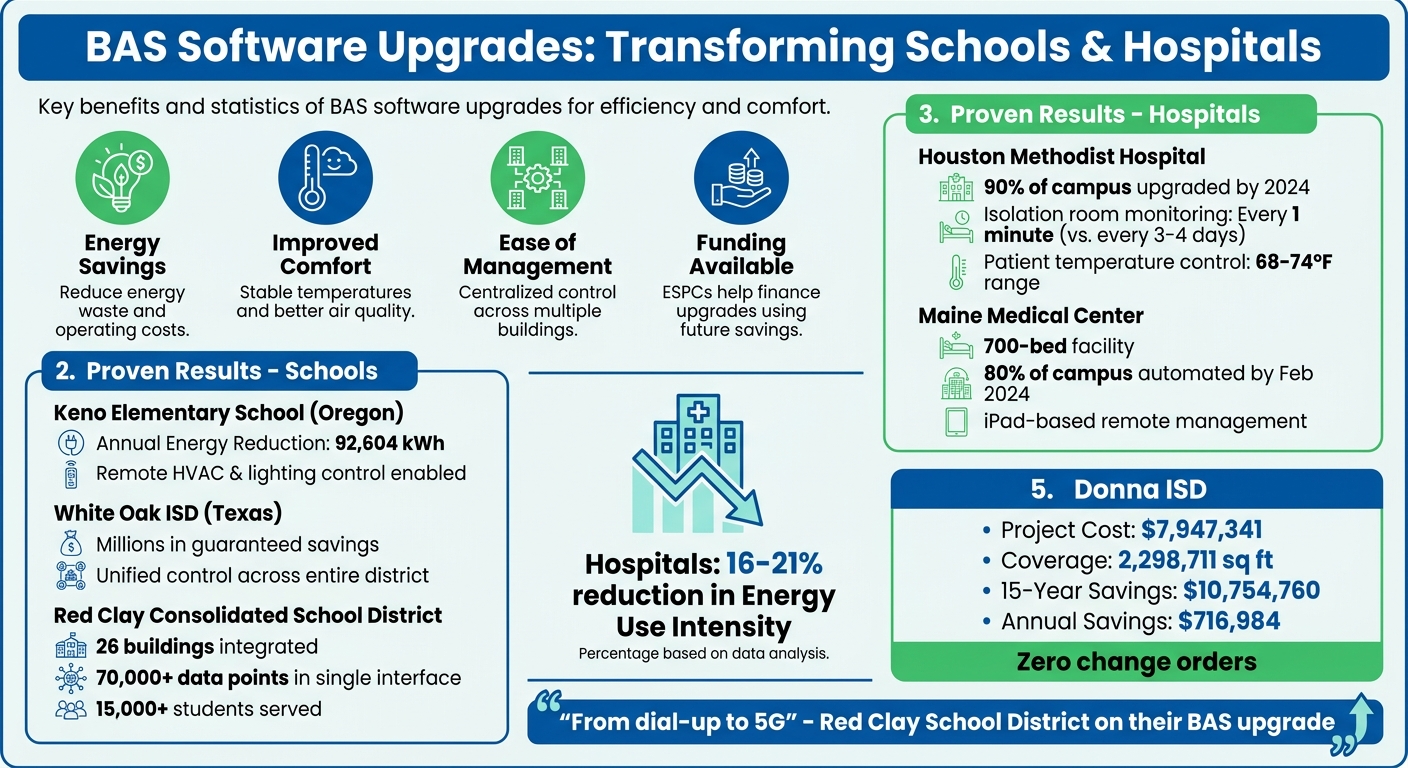
- Energy savings: Modern BAS software reduces energy waste and operating costs. Example: Keno Elementary saved 92,604 kWh annually.
- Improved comfort: Enhanced HVAC controls ensure stable temperatures and better air quality.
- Ease of management: Centralized systems simplify operations, even across dozens of buildings.
- Funding options: Programs like Energy Savings Performance Contracts (ESPCs) help finance these upgrades using future savings.
Case studies show how schools and hospitals are benefiting from BAS upgrades, with institutions like White Oak ISD and Houston Methodist Hospital achieving millions in savings and enhanced reliability. Partnering with experienced contractors like E3 ensures projects are completed efficiently and deliver guaranteed results.
BAS Software Upgrade Benefits: Energy Savings and ROI for Schools and Hospitals
Benefits of BAS Software Upgrades
Energy Efficiency and Cost Savings
Upgrading BAS software can significantly reduce energy waste by optimizing HVAC and lighting systems. Modern systems provide real-time visibility, allowing facilities to quickly identify and address inefficiencies. As the Red Clay Consolidated School District described it, the shift is like moving from "dial-up to 5G", enabling faster resolution of energy-related issues [3].
A great example of these benefits can be seen in the White Oak Independent School District. Their upgraded BAS allowed for precise monitoring and control, which directly contributed to guaranteed savings. Superintendent Michael Gilbert highlighted this success:
We are pleased to address our infrastructure needs without negatively impacting our budget by relying on Schneider Electric‘s energy savings guarantee. [2]
Another advantage of upgraded BAS software is its ability to unify control systems. For instance, Red Clay Consolidated School District successfully integrated 26 buildings and over 70,000 data points into a single interface, streamlining operations and improving efficiency [3].
Better Comfort and Indoor Air Quality
Upgraded BAS systems don’t just cut costs – they also improve comfort and air quality. Enhanced HVAC controls provide more reliable heating, cooling, and ventilation, while faster processing speeds ensure quicker adjustments to maintain stable indoor conditions. This helps eliminate uncomfortable temperature swings and ensures better air quality.
In 2023, Red Clay Consolidated School District upgraded its BAS across 26 buildings, serving over 15,000 students. By deploying the latest Niagara BAS management software and upgrading 28 JACE controllers to the N4 generation, they gained greater visibility into their building operations and improved system reliability [3].
Better System Integration and Scalability
Modern BAS platforms also excel in integration and scalability, making it easier to adapt and grow. These systems support phased implementation, which means facilities can add new components – like LED lighting controls or extra HVAC units – when budgets allow. For example, the White Oak Independent School District started with a Phase I BAS installation and later expanded it with additional upgrades [2].
Future-ready controllers and software ensure that systems remain compatible with new technologies. Red Clay Consolidated School District unified previously independent systems into one centralized interface, simplifying management across multiple buildings [3].
sbb-itb-034f8e1
Case Studies: BAS Upgrades in Schools and Hospitals
School District: Energy Efficiency for K-12 Campuses
The Klamath County School District in Oregon made impressive strides in energy conservation at Keno Elementary School, cutting annual energy usage by 92,604 kWh. This was achieved by upgrading to modern BAS (Building Automation System) software. Under the leadership of Maintenance Director Dennis Zullo, the district gained the ability to remotely manage HVAC and lighting systems, freeing up funds for additional projects, such as replacing water heaters dating back to the 1940s [1].
Financial support from the Energy Trust of Oregon played a key role in making these upgrades affordable. Zullo explained the financial benefits:
With incentives from Energy Trust, you could save 50% on a heating project or lighting project. That goes a long way for the school district because you only have so much money in the budget. [1]
The new BAS software also allowed technicians to fine-tune classroom temperatures and control lighting remotely, significantly reducing the need for on-site maintenance visits. Speaking to the broader impact, Zullo remarked: "I feel that we should conserve it and at least try to do what we can to help our community out" [1]. This example highlights how upgrading to modern BAS systems can lead to measurable energy efficiency gains for schools.
Hospitals, too, are leveraging BAS upgrades to improve both operational reliability and patient comfort.
Hospital: Optimized Comfort and Reliability
Healthcare facilities have strict operational demands, particularly when it comes to environmental control. Upgrading BAS systems has proven essential for ensuring patient safety and comfort while enhancing overall efficiency.
At Houston Methodist Hospital, a five-year BAS modernization project – completed by 2024 – transformed 90% of the campus with smart HVAC controls. Led by James A. Law III, Manager of Facilities Management Services, the upgrade replaced outdated pneumatic systems with advanced digital automation. One major improvement was the ability to monitor isolation room negative air pressure every minute, compared to manual checks that previously occurred every three to four days [4].
The upgraded system also improved patient satisfaction by allowing them to adjust their room temperature within a safe range of 68 to 74 degrees Fahrenheit. Law underscored the importance of these upgrades:
We have critical areas like operating rooms, isolation rooms and biosafety level 3 labs that require constant monitoring of critical environmental conditions that we could not do with a pneumatic system. [4]
Similarly, Maine Medical Center, a 700-bed facility in Portland, upgraded 80% of its campus with automated controls by February 2024. Senior Director of Plant Engineering David Neely noted that technicians now use iPads to manage temperature and humidity remotely, leading to faster response times and greater efficiency [4].
These examples from hospitals demonstrate how BAS upgrades not only improve operational reliability but also enhance patient comfort, addressing the unique challenges of healthcare environments.
Partnering with E3 Design-Build Contractor for BAS Upgrades
E3’s Experience in BAS Solutions
E3 brings together a century of combined expertise in energy management and design-build services, focusing on modernizing Building Automation Systems (BAS) for schools and hospitals [6]. Based in Texas, the company has worked with over 350 clients across the state, giving them deep insights into the specific challenges faced by educational and healthcare facilities [6].
What makes E3 stand out is their integrated design-build model. By having in-house engineers and contractors collaborate from the start, they ensure BAS designs are both practical and seamlessly implemented. This approach eliminates the miscommunication that often arises in projects where designers and builders work independently. E3 begins with a thorough diagnostic process to identify issues like poor indoor air quality, discomfort, deferred maintenance, or high energy costs. As E3 explains:
We understand energy management means more than simply addressing maintenance issues. It means creating the most sustainable and comfortable environments to free resources for your real mission [6].
This hands-on experience allows them to deliver tailored solutions, especially for environments as sensitive as schools and hospitals.
Custom Solutions for Schools and Hospitals
E3 takes a tailored approach to BAS upgrades, specifically designed to meet the operational needs of educational and healthcare facilities. For schools, they schedule installations during nights and weekends to avoid disrupting classes. Rudy Rodriguez, Director of Maintenance at one school district, praised this strategy:
They came in on nights and weekends so we never disrupted any classes [6].
E3 doesn’t just stop at BAS upgrades – they integrate these systems with high-efficiency HVAC and LED lighting retrofits for a comprehensive energy solution. For example, at Donna ISD, E3 carried out a $7,947,341 energy-efficiency program across 2,298,711 square feet of facilities. This project included BAS installations at six campuses, retrofitting over 21,000 LED fixtures at 20 campuses, and mechanical upgrades at nine campuses. Remarkably, the entire project was completed with zero change orders [7].
By focusing on custom solutions, E3 ensures both immediate and lasting benefits for their clients.
Long-Term Value with E3
The benefits of working with E3 go far beyond the initial installation. In the case of Donna ISD, the project is expected to save the district $10,754,760 over 15 years, averaging annual savings of about $716,984 [7]. Dr. Daniel Trevino, Jr., Superintendent at another district, shared an even quicker success story:
We realized our annual savings estimate in just over eight months of tracking [6].
E3’s integrated approach keeps budgets and timelines under control, minimizing unexpected costs or delays. They back their projects with guaranteed results, as they emphasize:
Effectiveness means you’ll see the results we guarantee you [6].
This commitment to accountability ensures clients achieve the energy savings and operational improvements promised. E3’s reputation is further solidified by their endorsement from the Texas Association of School Boards (TASB), a recognition of their ability to serve districts of all sizes and locations across Texas [6].
Case Study: Implementing automated BAS Cx in Schools and Campuses
Conclusion
Upgrading Building Automation Systems (BAS) in schools and hospitals offers measurable improvements in efficiency, comfort, and reliability. With modern BAS software leveraging data and trend analysis, equipment issues can be identified more quickly, leading to an estimated 16% to 21% reduction in Energy Use Intensity for hospitals [8]. In schools, these upgrades streamline control over tens of thousands of data points [3]. Hospitals benefit from features like automated HVAC adjustments based on patient discharge schedules and surgical calendars, which boost operational efficiency [5]. These advancements not only enhance functionality but also translate into significant cost savings.
The financial benefits of BAS upgrades allow schools and healthcare facilities to redirect savings toward their primary missions – education and patient care. Reports consistently show that the long-term savings from these systems far outweigh the initial investment.
Upgraded systems also contribute to healthier and more comfortable environments. Features like advanced indoor air quality monitoring, accessible through touchscreen displays and mobile apps, empower occupants to better control their surroundings. Maintenance tools that prioritize issues by severity and recommend timely solutions ensure smoother operations [5].
To maximize the value of these upgrades, working with experienced contractors is key. E3 Design-Build Contractor offers an integrated design-build approach that delivers customized BAS solutions with guaranteed results. They are a trusted partner for schools and hospitals looking to modernize their systems.
Reach out to E3’s team today for a personalized BAS upgrade assessment.
FAQs
How do I know if my BAS is outdated?
Is your Building Automation System (BAS) showing its age? Here are some telltale signs to watch for:
- Frequent Breakdowns: Constant repairs and system malfunctions could indicate that your BAS is struggling to keep up.
- Rising Energy Costs: An outdated system often operates inefficiently, driving up energy bills.
- Inconsistent Temperature Control: If maintaining a steady, comfortable indoor climate feels like a losing battle, your BAS might be the culprit.
- No Remote Monitoring: Modern systems allow you to monitor and control settings from anywhere. A lack of this feature can hinder efficiency and responsiveness.
- Outdated Hardware or Software: If your system no longer supports updates or can’t integrate with newer technologies, it’s likely time for an upgrade.
Upgrading your BAS can lead to better energy efficiency, improved reliability, and easier facility management. It’s an investment that pays off in both performance and savings.
What does a BAS software upgrade typically include?
A BAS software upgrade usually includes several key steps: sensor calibration, controller inspection, network verification, and CMMS integration. These processes are designed to keep the system running smoothly, reduce errors, and boost both performance and reliability.
How can schools or hospitals pay for a BAS upgrade?
Schools and hospitals have several ways to fund upgrades for Building Automation Systems (BAS). One popular method is through energy savings performance contracts (ESPCs). These contracts let institutions pay for upgrades using the cost savings generated by improved energy efficiency, eliminating the need for upfront investments.
Other funding options include grants, rebates, and tax credits, which can further reduce financial barriers. These approaches make it possible for schools and hospitals to modernize their facilities while relying on the long-term savings and operational benefits of energy-efficient systems.