

- test :
Schools in Texas are tackling rising utility costs and outdated infrastructure by implementing Building Automation Systems (BAS). These systems centralize HVAC and lighting controls, improving energy efficiency while reducing costs. Here’s a quick look at the impact:
- Donna ISD: Invested $7.9M to upgrade six campuses with BAS, LED lighting, and HVAC systems. Annual savings: $716,984, projected 15-year savings: $10.75M.
- Bryan ISD: A $6.4M project funded by a 2% SECO LoanSTAR loan optimized energy systems across 19 campuses. Annual savings: $763,908.
- Clyde CISD: Replaced 113 HVAC units, cutting utility costs by 16.1%, saving over $1.16M in 20 years.
- White Oak ISD: Upgraded a chilled water plant and HVAC systems, reducing electricity use by 2M kWh annually.
These projects not only save money but also improve air quality and comfort for students and staff. By using smart funding options like SECO loans and Energy Savings Performance Contracts, schools modernize without exceeding budgets.
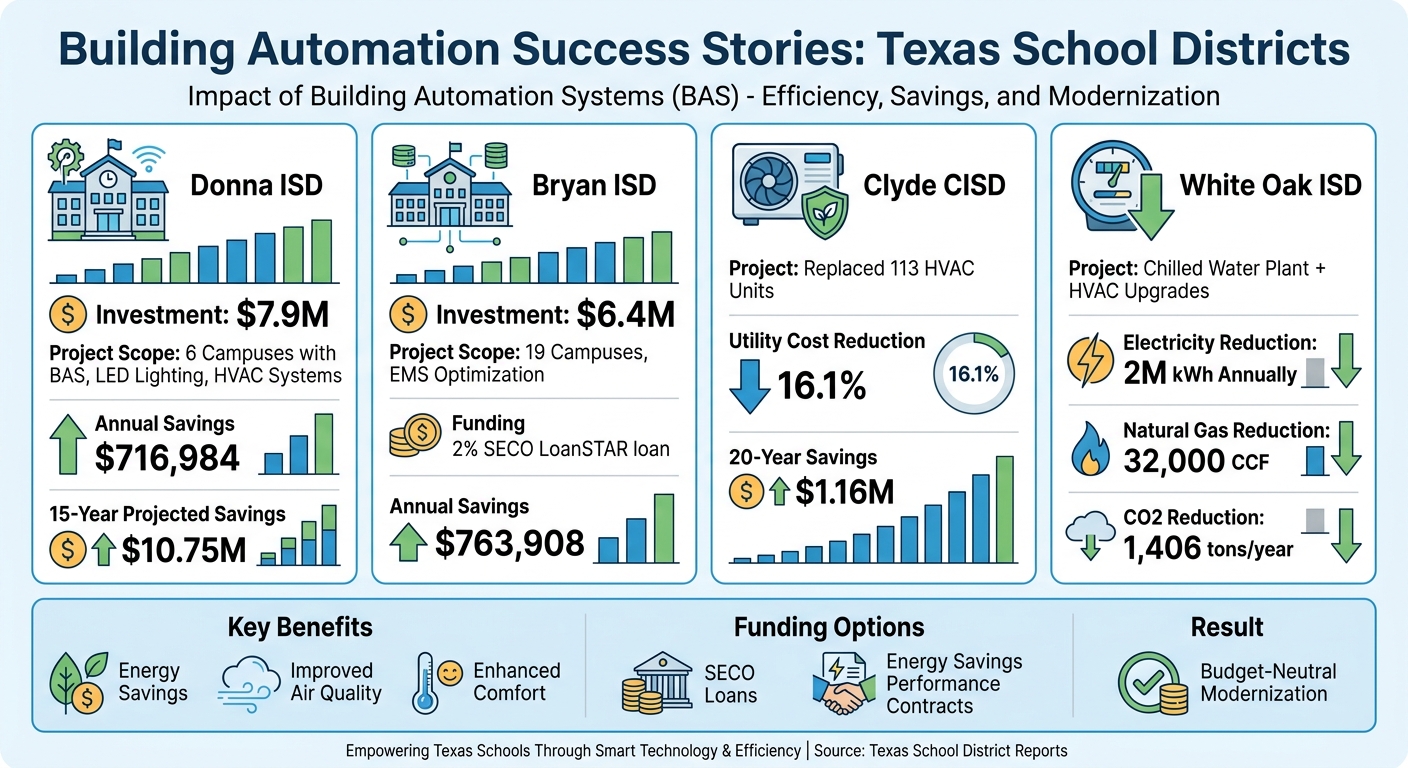
Texas School Districts Energy Savings from Building Automation Systems
Automation Systems for School Buildings
sbb-itb-034f8e1
Energy Efficiency Problems in Texas Schools
Before implementing building automation, schools in Texas faced mounting challenges from aging and inefficient systems. These issues led to soaring costs, uncomfortable indoor conditions, and outdated infrastructure that were difficult to manage.
High Utility Bills
Aging systems were a major culprit behind rising utility expenses. As equipment deteriorated, energy consumption surged. For example, in 2021, Clyde Consolidated Independent School District (CISD) tackled this issue by teaming up with Schneider Electric. The district replaced 113 outdated HVAC rooftop units across its high school and junior high, while also upgrading lighting throughout its facilities. This initiative is expected to cut utility costs by 16.1%, saving over $1,161,120 over the next 20 years [3].
"In recent years, Clyde CISD has been challenged with increasing energy and operational costs due to aging infrastructure that was consuming increasing amounts of energy over time." – Schneider Electric [3]
White Oak ISD faced similar hurdles. Their failing chilled water plant, along with 22 outdated HVAC units, was driving up costs. To address this, the district undertook a $2.5 million infrastructure overhaul. The upgrades are projected to save more than 2 million kilowatt-hours of electricity and 32,000 centum cubic feet of natural gas [4]. Without centralized control systems, districts like these couldn’t monitor energy usage effectively, often wasting energy by heating or cooling unoccupied spaces.
Poor Temperature Control and Air Quality
Outdated HVAC systems didn’t just increase costs – they also disrupted learning environments. In some cases, failing systems forced temporary school closures. For instance, at Grand Prairie ISD, temperatures inside classrooms exceeded 78°F for hours at a time. To solve this, the district implemented wireless control devices as part of a pilot program spearheaded by IT Manager Tony Hawkland. These devices not only eliminated shutdowns but also saved the district $3.5 million [7].
The lack of modern controls meant schools couldn’t adjust temperatures across different zones in real time. This led to uneven conditions, where some areas were too hot while others were uncomfortably cold, further affecting the learning experience.
Outdated Building Systems
Old infrastructure presented significant management challenges. Many districts relied on manual switches and individual building operations without centralized monitoring. Without energy meters, administrators had no way to pinpoint where energy was being wasted. This lack of oversight, coupled with frequent equipment failures, drove up maintenance costs. Additionally, proprietary systems often locked schools into expensive vendor contracts, leaving them with limited options for repairs or replacements.
The financial strain was evident. White Oak ISD, for example, used a $2.5 million energy savings performance contract to fund critical upgrades [4].
"We strive to create a comfortable and safe environment where our students can learn and grow, and that becomes increasingly challenging as our facilities age." – Michael Gilbert, Superintendent, White Oak ISD [4]
Without modern building automation, districts found themselves stuck in a costly cycle of reactive maintenance and emergency repairs. These outdated systems made it nearly impossible to provide the safe and comfortable learning environments that students deserve. Centralized building automation stands out as a solution to improve oversight, reduce waste, and minimize reactive maintenance.
E3’s Building Automation System Implementation
E3 Design-Build Contractor specializes in delivering energy efficiency programs that combine Building Automation Systems (BAS), mechanical upgrades, and LED lighting retrofits. Their approach includes a turnkey design-build model and utility assessment reports tailored for state funding programs like SECO LoanSTAR.
Step-by-Step Installation Process
E3 employs a structured installation process to tackle energy efficiency challenges. It all starts with a detailed utility assessment to pinpoint the most impactful upgrades in HVAC, lighting, and automation systems. What makes their approach stand out is their "occupied retrofit" method, which allows them to carry out upgrades during the school year without interrupting classes or educational activities. A great example is Bryan ISD, which completed a $6,421,852 project between June 2020 and 2021 using this method, ensuring classes continued smoothly [2].
For older campus systems, E3 uses nonproprietary equipment with open protocols like BACnet, ensuring seamless integration. They also update documentation for wiring, conduits, relays, and switches to maintain accuracy. Major installations are strategically scheduled during low-occupancy periods, such as winter breaks, to minimize disruptions [8].
System Upgrades and Components
E3 integrates a range of technologies to deliver maximum energy savings. In Donna ISD’s $7,947,341 program, they installed BAS at six campuses, upgraded mechanical systems at nine, and replaced over 21,000 LED fixtures. At Veterans Middle School alone, more than 80 HVAC units were replaced [1]. Similarly, Bryan ISD’s project included EMS optimization across 19 campuses, district-wide LED retrofits at 24 facilities, bipolar ionizers at 18 campuses, and power conditioning upgrades at 23 sites [2]. These centralized systems ensure HVAC and lighting operate at peak performance.
Tailored Solutions for School Districts
E3 designs solutions that align with each district’s unique needs and budgets. For example, while LED retrofits were implemented across 20 campuses, BAS installations were concentrated on six campuses where they would make the biggest impact [1]. The Donna ISD project (spanning 2,298,711 sq ft) was completed with zero change orders, while Bryan ISD benefited from a 2% interest SECO LoanSTAR loan, repaid through energy savings [2].
Infrastructure upgrades also include server and firmware updates and transitioning to dedicated utility command networks to enhance cybersecurity. These improvements ensure the automation systems are ready to meet future demands [8]. By tailoring their approach to each district, E3 sets the stage for long-term energy savings and improved operational performance across facilities.
Energy Savings and Performance Results
After implementing comprehensive BAS installations, school districts have experienced noticeable savings and improved facility performance.
Reduced Energy Use and Costs
E3’s BAS installations have delivered annual savings between $716,984 and $763,908 for Texas schools, with long-term savings projected to surpass $10 million over 15 years. For instance:
- Donna ISD invested $7,947,341, saving $716,984 annually, with a 15-year projection of $10,754,760 [1][2].
- Bryan ISD achieved $763,908 in yearly savings from a $6,421,852 investment [1][2].
- White Oak ISD cut over 2 million kilowatt-hours of electricity and 32,000 centum cubic feet of natural gas annually, with guaranteed savings exceeding $4.4 million over the contract term [5].
- Clyde CISD reduced utility costs by 16.1%, resulting in more than $1,161,120 in guaranteed savings over 20 years [3].
These projects were often funded through Energy Savings Performance Contracts and SECO LoanSTAR loans, allowing districts to finance upgrades with the savings generated from reduced energy use.
The financial benefits are just one part of the story – these upgrades have also significantly improved indoor conditions.
Better Indoor Comfort
The BAS and HVAC system upgrades have resolved long-standing comfort issues across campuses. For example:
- White Oak ISD introduced separate temperature controls for auditorium stages and seating areas, addressing the unique needs of multi-use spaces [5].
- Donna ISD replaced outdated classroom equipment with automated, modern systems, ensuring consistent climate control and better air quality throughout the school day [1].
These changes have created more comfortable and reliable environments for both students and staff.
Lower Carbon Emissions
The energy efficiency measures have also delivered environmental benefits. For example:
- White Oak ISD reduced carbon dioxide emissions by 1,406 tons annually [5].
- Clyde CISD cut greenhouse gas emissions by 391 tons [3].
These reductions not only support environmental goals but also align with broader sustainability efforts while providing clear financial returns for Texas schools.
Installation Steps: From Audit to Monitoring
E3 follows a well-structured process to ensure that building automation systems (BAS) integrate smoothly with existing school infrastructure while keeping classroom disruptions to a minimum.
Energy Audits and System Assessment
The first step is conducting a utility assessment report tailored to meet the State Energy Conservation Office (SECO) requirements for LoanSTAR funding. This evaluation takes a deep dive into district-wide infrastructure, covering key areas like lighting, HVAC systems, and existing Energy Management Systems (EMS) across all campuses [2].
E3’s evaluations are thorough, spanning multiple campuses to determine where existing systems can be fine-tuned versus where full mechanical retrofits are necessary. The assessment also considers specialized upgrades, such as improving indoor air quality and enhancing power conditioning. All upgrades are scheduled carefully during the school year to avoid interrupting classes. Once the assessment is complete, the project transitions seamlessly into the integration of hardware and software.
BAS Hardware and Software Setup
From start to finish, E3 oversees the entire process, ensuring the new BAS hardware integrates effectively with current systems to improve energy management. This setup often works in tandem with other upgrades, like LED lighting installations and HVAC replacements, creating a unified platform for managing energy use.
For example, at Bryan ISD, E3 optimized the Energy Management System across 19 campuses and implemented power conditioning improvements in 23 facilities. These projects adhered to the same high standards, even in occupied buildings [2]. With the hardware in place, the focus shifts to equipping school staff with the tools and knowledge needed to operate the system effectively.
Staff Training and System Monitoring
E3’s monitoring systems use advanced sensors that automatically alert staff to system performance and status changes. These systems are designed for remote access, enabling staff to manage everything from individual fixtures to entire building systems using laptops or tablets [6]. Additionally, the monitoring platform includes predictive analytics to enhance operational efficiency. This streamlined approach ensures that energy savings and comfort improvements are maintained over time, empowering school staff to confidently manage the systems long after installation.
Long-Term Benefits and District-Wide Expansion
Building automation systems (BAS) continue to provide lasting advantages, from energy savings to streamlined maintenance, making them a valuable investment for schools aiming to modernize their infrastructure.
Continued Energy Savings
The financial benefits of BAS grow over time, offering schools a way to reinvest savings into other priorities. For instance, Donna ISD’s project is expected to save an impressive $10,754,760 over 15 years, while Bryan ISD has already achieved $763,908 in annual savings through energy management system (EMS) optimization and power conditioning [1][2]. These projects utilized budget-neutral funding options like Energy Savings Performance Contracts and SECO LoanSTAR loans, ensuring modernization efforts didn’t pull resources away from education. The energy savings don’t just stop at reduced utility bills – they also help minimize repair costs by decreasing equipment strain.
Reduced Maintenance Requirements
Upgrades to modern systems mean fewer breakdowns and longer-lasting equipment. At Donna ISD, replacing over 80 HVAC units and retrofitting 21,000 LED fixtures drastically cut maintenance needs and extended the lifespan of key infrastructure [1]. Similarly, Bryan ISD enhanced 23 facilities with power conditioning, protecting electronics and motors from electrical surges, which helps prevent early equipment failures [2]. BAS also allows facilities teams to monitor systems remotely, spotting and addressing issues before they escalate into expensive repairs. This proactive approach not only saves money but also ensures operational reliability, paving the way for district-wide scalability.
Expansion to Other Campuses
With proven success and reduced upkeep, districts can confidently expand BAS across more campuses. Donna ISD’s project, for example, covered 2,298,711 square feet, including LED retrofits at 20 campuses, BAS installations at 6 campuses, and mechanical upgrades at 9 campuses – all completed without a single change order, staying within the original $7,947,341 budget [1]. By rolling out improvements in phases, districts can focus on the most urgent needs first while planning upgrades for the rest. Standardizing infrastructure across campuses also simplifies operations, training, and maintenance, as facilities teams can manage everything through one unified system. This consistency makes district-wide energy management much more efficient and effective.
Conclusion: E3’s Impact on Texas School Districts
E3’s approach to building automation has led to impressive results across Texas schools. Take Donna ISD, for example: their $7.95 million project spanned 2.3 million square feet across 20 campuses, resulting in annual savings of $716,984 and a 15-year savings projection of $10.75 million – all achieved without a single change order [1].
What makes E3 stand out is its ability to combine technical expertise with smart funding strategies. A key feature of their work is the focus on occupied retrofits, allowing installations to happen during the school year without disrupting students or staff. At Bryan ISD, this method not only improved air quality and optimized the energy management system (EMS) but also delivered $763,908 in annual savings. This was accomplished using budget-neutral SECO LoanSTAR loans [2]. These immediate savings pave the way for lasting operational enhancements.
Beyond immediate financial benefits, E3’s strategy improves comfort and efficiency across entire districts. Upgraded, reliable equipment reduces maintenance needs, while remote monitoring allows for proactive issue management. As districts see the value of these systems, they can confidently expand building automation system (BAS) applications to more campuses, streamlining energy management on a larger scale.
FAQs
How fast do BAS projects pay for themselves in schools?
Building automation system (BAS) projects in schools often recoup their costs within 3 to 7 years. This payback period is made possible thanks to energy savings and streamlined operations, as highlighted in case studies from various Texas school districts.
Will a BAS installation disrupt classes during the school year?
A well-planned and carefully executed Building Automation System (BAS) installation can be completed without disrupting school activities. For instance, case studies from Texas school districts highlight how these projects are strategically managed to limit any impact. Work is often scheduled during school breaks or after regular hours to avoid interference. Contractors with expertise, such as E3 Design-Build, focus on ensuring the upgrades enhance energy efficiency and comfort while keeping classroom routines uninterrupted.
What funding options can Texas districts use for BAS upgrades?
Texas school districts have several avenues to secure funding for facility improvements. One major source is the Texas Legislature’s $8.5 billion public education package, which helps finance projects like building automation systems. Districts can also explore bonds, though these require community approval, as well as federal programs like E-rate. Another option includes low-interest loans through initiatives such as LoanSTAR. Additionally, legislative efforts like HB 2 offer increased funding for capital projects, allowing districts to prioritize energy-efficient upgrades.