

- test :
Buildings waste up to 40% of global energy due to inefficient operations. Predictive energy analytics offers a smarter way to manage energy by using AI and machine learning to forecast demand and optimize usage. These systems analyze data like weather, occupancy, and equipment performance to reduce energy waste and costs.
Key Benefits:
- Lower Energy Use: Reduces total energy consumption by up to 25%.
- Peak Demand Savings: Cuts peak energy usage by 30%.
- Improved Maintenance: Detects issues early, reducing unplanned maintenance by 20%.
- Cost Efficiency: Aligns energy use with demand, saving money for schools, hospitals, and public facilities.
- Sustainability Goals: Reduces CO₂ emissions by 25%-30% while supporting renewable energy integration.
By integrating IoT sensors, machine learning, and existing building systems, predictive analytics transforms facility management, ensuring smarter energy use and better performance. The article dives into how this approach works and its impact on public facilities.
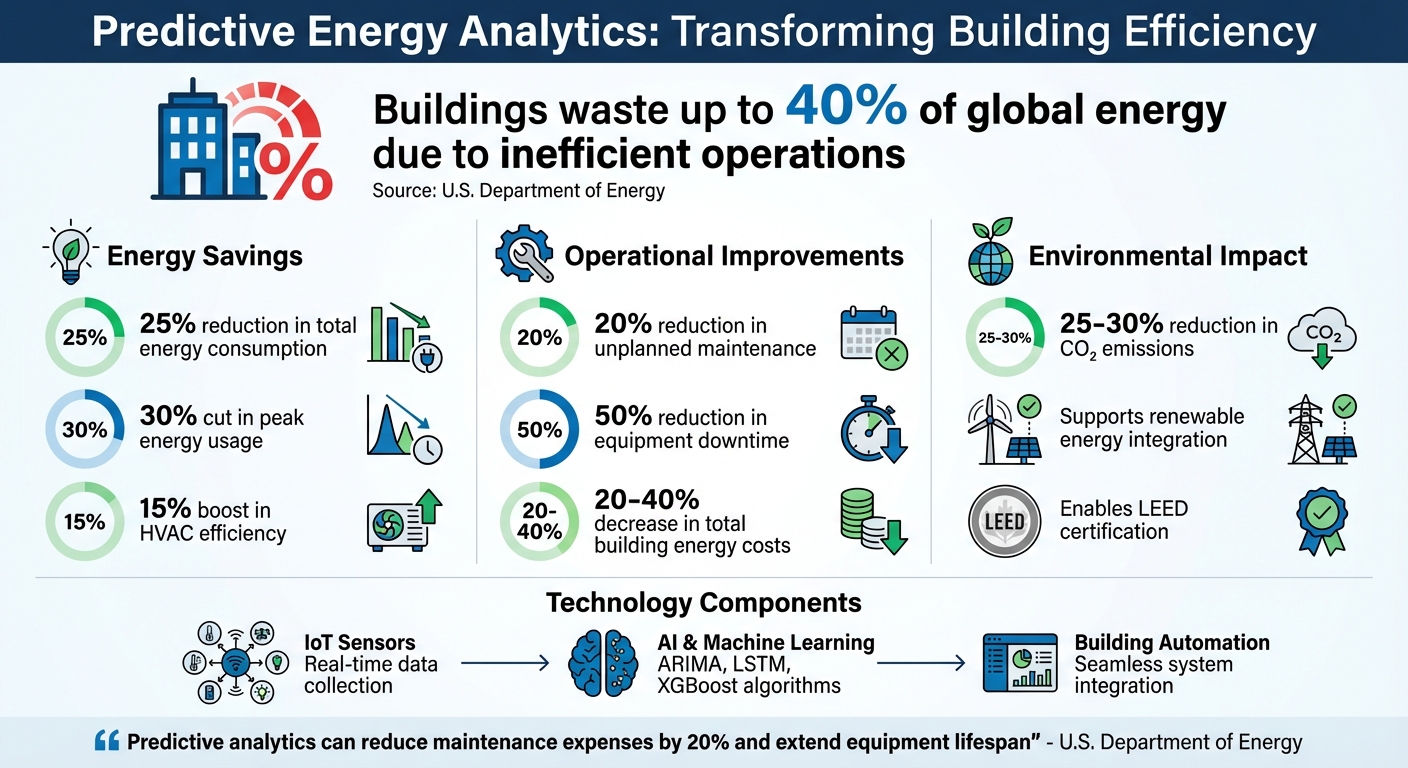
Predictive Energy Analytics Benefits: Cost Savings and Efficiency Metrics
SBA 479: Role of AI and Machine Learning in HVAC Energy Optimization
sbb-itb-034f8e1
What is Predictive Energy Analytics?
Predictive energy analytics uses AI-driven insights to anticipate energy needs and make proactive adjustments based on both historical and real-time data. By leveraging IoT sensors, these systems monitor factors like temperature, humidity, occupancy, lighting, and utility usage. Advanced machine learning models – such as ARIMA, LSTM, and XGBoost – analyze this data to predict occupancy patterns, weather conditions, and equipment performance, enabling smarter energy management strategies [1].
"Traditional building management systems are reactive rather than predictive, leading to substantial energy waste." – Ibrahim Shittu, Senior Software Engineer
This approach allows for automated energy optimization across building systems. For instance, techniques like "daylight harvesting" adjust artificial lighting based on natural daylight availability, while strategic load management reduces grid demand during peak hours.
Main Features of Predictive Energy Analytics
Predictive energy analytics integrates three essential components: data collection, simulation modeling, and future forecasting.
- Data Collection: This layer gathers a wide range of metrics, such as time-based energy usage patterns, weather forecasts, and external factors like utility pricing [1].
- Simulation Modeling: Using this data, simulation models replicate how a building consumes energy under various conditions. For example, they can identify inefficiencies like simultaneous heating and cooling, which can waste 15% to 25% of HVAC energy [2].
- Future Forecasting: These models predict future conditions to optimize energy usage. Take a school building as an example – if sensors detect it will be mostly empty on a mild Friday afternoon, the system can lower airflow to 40% of design capacity in underutilized areas, cutting fan energy consumption by up to 80% [2].
Predictive vs. Reactive Energy Monitoring
The primary difference between predictive and reactive energy approaches lies in timing and intelligence. Reactive systems work on fixed schedules or respond to issues after they arise. For instance, an HVAC system might cool an office floor to 72°F every weekday morning at 7:00 AM, regardless of whether the space is occupied. Predictive systems, on the other hand, use real-time IoT data and forecasting to avoid energy waste before it happens. They optimize HVAC settings based on actual occupancy, detect early signs of equipment wear to schedule maintenance, and actively participate in demand response programs to lower peak energy charges [1].
| Feature | Reactive Energy Monitoring | Predictive Energy Analytics |
|---|---|---|
| Approach | Reacts after inefficiencies occur | Anticipates and prevents inefficiencies |
| Data Usage | Limited to historical data and basic alerts | Combines real-time IoT data with forecasts |
| HVAC Control | Relies on fixed schedules or manual inputs | Dynamically adjusts based on occupancy and forecasts |
| Maintenance | Reactive (fix-on-failure) or rigid schedules | Proactive, based on performance trends |
| Grid Interaction | Passive energy use | Active demand response and peak load management |
These differences highlight how predictive systems go beyond traditional methods, integrating seamlessly with building automation to deliver continuous, intelligent energy optimization.
Core Components of a Predictive Energy Analytics System
A predictive energy analytics system is built on three key layers: sensors for data collection, AI and machine learning algorithms, and integration with building automation systems. Together, these layers transform raw building data into actionable insights, enabling a shift from reactive to proactive energy management. This collaboration creates a smarter, more efficient approach to energy use.
Sensors for Data Collection
The first layer involves sensors that gather real-time data critical for informed decisions. For instance, occupancy sensors – like radar, PIR movement detectors, and Wi-Fi connection counters – track how spaces are used. This data allows systems to anticipate and adjust energy use, reducing waste in unoccupied areas. Environmental sensors measure factors like temperature, humidity, and CO₂ levels. CO₂ sensors are particularly impactful in demand-controlled ventilation, where airflow adjusts based on actual occupancy, potentially cutting energy use by up to 55% [4].
Utility meters and submeters provide granular insights into electricity, gas, and water usage. By pinpointing high-consumption areas, these tools help identify where optimization efforts can have the most impact. Meanwhile, equipment health sensors – such as barometric pressure sensors for clogged filters, magnetic current sensors for motor performance, and MEMS microphones for compressor anomalies – support predictive maintenance, reducing unexpected repairs by 20% [1]. Light sensors further enhance efficiency by adjusting artificial lighting based on natural illumination levels, aiding in daylight harvesting. Together, these sensors provide the foundation for advanced energy-saving strategies.
AI and Machine Learning Algorithms
The intelligence layer processes the collected sensor data, turning it into actionable predictions and strategies. Supervised learning algorithms, such as Random Forest, can predict building energy use with up to 5% accuracy over 24-hour periods, enabling better load management [5]. Time-series models, like LSTM networks, track temperature changes over time and adjust systems to maintain comfort while minimizing energy consumption. A standout example is Deep Reinforcement Learning, used by Google’s DeepMind to cut data center cooling energy by 40% through optimized control strategies [5].
"Artificial intelligence fundamentally reimagines HVAC control as a predictive, adaptive process. Instead of responding to current conditions, AI systems anticipate future states based on historical patterns, weather forecasts, occupancy predictions, and hundreds of other variables." – HVAC Laboratory [5]
Unsupervised learning methods, such as K-means clustering, uncover anomalies and group similar thermal behaviors across building zones. These techniques reveal optimization opportunities that traditional rule-based systems might overlook, ensuring continuous improvement in energy management.
Integration with Building Automation Systems
The final layer connects predictive intelligence to physical building systems. Instead of replacing existing Building Automation Systems (BAS), the best approach adds an AI supervisory layer to optimize setpoints while retaining the BAS’s role in safety and equipment protection [5]. Protocol gateways help translate legacy protocols like BACnet, Modbus, and LonWorks into standardized formats that AI can process. Edge computing manages time-sensitive tasks locally to reduce delays, while cloud platforms handle complex model training and large-scale analysis. This hybrid setup ensures buildings remain operational even during internet outages while benefiting from advanced optimization.
Standardized taxonomies, like Project Haystack or Brick Schema, ensure consistency across various systems, making predictive models scalable and transferable. For example, Microsoft’s Redmond campus processes 500 million daily data transactions from 30,000 devices, achieving 15% to 25% energy savings through optimized chiller plant sequencing and VAV box adjustments [5]. This integration turns raw data into a seamless, intelligent energy management system.
How Predictive Energy Analytics Works
Predictive energy analytics shifts building automation from a reactive approach to a proactive one. By collecting data from sensors, applying machine learning models, and refining predictions over time, it allows buildings to anticipate energy needs rather than merely reacting to current conditions. The process starts with gathering raw data and transforming it into actionable insights.
Data Collection and Preprocessing
The first step involves collecting data from various sources throughout the building. IoT sensors monitor factors like temperature, humidity, occupancy, and lighting, while smart meters track electricity, gas, and water usage. External weather APIs provide forecasts to help predict future energy demands. Together, these inputs create a detailed picture of the building’s operations [1][6].
Raw data needs cleaning before it can be processed. Outliers are removed using percentile analysis, and missing values are filled through interpolation. For instance, cumulative meter readings can be converted into instantaneous consumption by calculating the difference between consecutive values [6]. Data is then normalized to a 0–1 range and structured into 3D tensors, making it ready for deep learning models like LSTM networks [8].
"Quality Over Quantity: Clean, reliable data is more valuable than massive amounts of noisy data" – Ibrahim Shittu, Senior Software Engineer [1]
Considering that buildings contribute 20% to 40% of global energy consumption, this preprocessing step is crucial for impactful optimization [6]. Once the data is clean and organized, machine learning models can identify patterns and predict energy usage.
Modeling and Forecasting Energy Usage
At this stage, the cleaned data becomes the backbone for energy forecasting. Machine learning algorithms can uncover complex, non-linear relationships in the data that traditional methods might overlook. LSTM networks, for example, use historical consumption data to forecast future energy needs [8][9]. These models also incorporate external factors like weather, occupancy schedules, and holidays to optimize HVAC and lighting systems proactively [1][6].
Accurate forecasting helps reduce costs through strategies like peak shaving – predicting high-demand periods and lowering consumption ahead of time. A notable example comes from the 2017 "Energy IN TIME" project in Bucharest, where Seq2Seq and RNN models forecasted energy usage with a Normalized Mean Absolute Error (NMAE) of 0.20 for 12-hour-ahead predictions [6].
Under Ibrahim Shittu’s leadership, Eco Energio implemented a predictive analytics system using LSTM and XGBoost algorithms. By integrating IoT sensors and weather data, the project achieved impressive results: a 25% cut in total energy usage, a 30% drop in peak demand, and a 15% boost in HVAC efficiency [1].
Validation and Continuous Improvement
To ensure accuracy, predictions are regularly compared with actual consumption data using metrics like Mean Absolute Error (MAE), Root Mean Squared Error (RMSE), and R-squared (R²) [7][8][9]. Tools like Optuna use Bayesian optimization to fine-tune hyperparameters – such as learning rates and layer sizes – for better model performance.
Feedback loops further improve predictions. Advanced systems update their models in real time by incorporating the latest actual observations into future forecasts [8]. Additionally, validation algorithms and sensor redundancy help mitigate issues like equipment failures or inconsistent data streams that could disrupt accuracy [1].
Models are often refined by splitting data into monthly segments to account for seasonal trends and shifting energy usage patterns [6]. This phased approach not only builds trust with facility managers but also ensures the system adapts to evolving building conditions. By continuously validating and refining its predictions, the system becomes a self-improving tool that supports proactive energy management.
Benefits of Predictive Energy Analytics for Public Facilities
Predictive energy analytics offers practical solutions for public facilities like schools, hospitals, and municipal buildings, which often face the dual challenge of reducing costs while maintaining comfort. By transforming raw data into actionable insights, these systems help facilities achieve measurable improvements in energy use and operational efficiency.
Cost Savings and Energy Efficiency
Managing peak energy demand effectively can lead to significant savings. With the help of IoT sensors and machine learning, predictive systems adjust HVAC and lighting based on real-time occupancy and weather forecasts, minimizing energy waste in unused areas.
Facilities using predictive analytics have seen notable decreases in energy consumption, peak demand, and HVAC inefficiencies.
"Predictive analytics in energy optimization represents a massive opportunity for both cost savings and environmental impact."
- Ibrahim Shittu, Senior Software Engineer [1]
The benefits go beyond lowering utility bills. These systems monitor equipment performance, identifying inefficiencies before they result in costly failures. By automating processes, facility staff can focus on other priorities. For facilities equipped with solar panels or battery storage, predictive analytics optimizes renewable energy use by aligning it with forecasted needs and grid pricing.
Improved Predictive Maintenance
Traditional maintenance often follows fixed schedules, regardless of an asset’s actual condition. Predictive analytics changes this by determining the best maintenance window based on factors like running time, load, and operational behavior [3].
Detecting faults early is another key advantage, as it allows maintenance teams to address issues before they escalate into major problems. This approach has led to a 20% reduction in unplanned maintenance tasks [1]. By fine-tuning equipment sequencing – such as rotating chillers – and avoiding unnecessary maintenance, facilities not only reduce downtime but also extend the lifespan of expensive equipment.
"In the high-stakes environment of modern commercial real estate, the failure of a critical HVAC unit is rarely a minor inconvenience; it is a catastrophic financial hemorrhage."
- AdvancedBuildings [10]
These maintenance strategies also contribute to broader environmental goals.
Support for Sustainability Goals
Predictive analytics helps public facilities meet sustainability mandates by enabling real-time carbon tracking and automating ESG reporting. This is particularly beneficial for schools, municipalities, and healthcare systems working to demonstrate progress toward environmental commitments [1].
The technology enhances renewable energy integration by forecasting solar generation and managing battery storage [1]. For events like school graduations or municipal meetings, predictive models use weather and occupancy forecasts to optimize air circulation and chiller operation in advance [3]. This "predictive pre-conditioning" ensures spaces are energy-efficient and comfortable without causing energy spikes.
Additionally, these systems contribute to grid stability through demand response management. By lowering energy use during peak periods, facilities reduce reliance on carbon-heavy power plants [1]. The insights generated also support applications for LEED and other green building certifications [1].
Implementation of Predictive Energy Analytics with E3 Design-Build Contractor

E3 Design-Build Contractor leverages predictive energy analytics to tackle persistent issues in Texas public facilities, including schools, municipalities, and healthcare systems. With a client base exceeding 350 across Texas and backing from the Texas Association of School Boards (TASB), E3’s methodology centers on three core principles: Experience, Efficiency, and Effectiveness [11].
Initial Data Collection and Assessment
The process kicks off by identifying specific challenges unique to each facility, such as excessive energy costs, deferred maintenance, or subpar indoor air quality. E3’s in-house engineering team conducts thorough site audits to establish a performance baseline. This baseline becomes the foundation for integrating predictive analytics and crafting solutions tailored to the facility’s needs [11]. By starting with such a detailed assessment, E3 ensures the groundwork is laid for impactful energy solutions.
Developing and Deploying Custom Energy Solutions
Using data from the initial assessment, E3 develops energy solutions designed to address the facility’s unique issues. Their integrated design-build model ensures smooth execution, covering everything from planning to installation. The in-house team focuses on implementing high-efficiency systems, such as HVAC upgrades, LED lighting, and Building Automation Systems, all tailored to the specific requirements of each facility.
As E3 puts it, “We only build what we design. Our engineers and contractors design and implement each project with precision.” This ensures that predictive analytics systems are seamlessly integrated with the upgraded infrastructure. Even facilities operating on tight budgets benefit from reduced costs and improved efficiency through this meticulous approach [11].
Monitoring and Optimization
Once the systems are installed, E3 doesn’t stop there. They use Building Automation Systems to track real-time energy data, ensuring the predicted savings are achieved and maintained. Dr. Daniel Trevino, Jr., Superintendent, shared his experience: “We realized our annual savings estimate in just over eight months of tracking.” Similarly, Don Meek, VP of Operations, emphasizes E3’s commitment to accountability: “You’ll never hear us say, ‘It’s not our problem.’”
These insights enable E3 to make continuous adjustments, ensuring the system adapts to evolving facility needs. Through ongoing monitoring and performance analysis, E3 guarantees that their predictive analytics systems consistently deliver measurable results [11].
Conclusion
Predictive energy analytics is transforming how public facilities manage energy by shifting the focus from reacting to energy demands to anticipating them. According to the U.S. Department of Energy, buildings equipped with automation systems can cut energy costs by up to 30% [12]. Similarly, AI-powered energy management systems deliver impressive savings, reducing total building energy costs by 20% to 40% [2]. These savings stem from dynamic adjustments based on factors like occupancy, weather patterns, and electricity pricing – far more effective than traditional static schedules.
The benefits go beyond just cutting costs. Predictive analytics also brings operational improvements. For example, predictive maintenance can reduce maintenance expenses by 20% and cut downtime by 50%, all while extending the lifespan of critical equipment [13]. For public entities often working with limited budgets and aging infrastructure, these advantages directly enhance both financial health and service quality.
On top of operational gains, the environmental impact is substantial. Facilities using predictive analytics can reduce CO2 emissions by 25% to 30%, aligning with regulatory standards and sustainability goals [13]. As Nick Dutton from Wirepas puts it:
"Industrial and commercial building automation is no longer a luxury but a necessity" [13].
Public facilities in Texas can turn to E3 Design-Build Contractor for tailored solutions that integrate predictive energy analytics with high-efficiency HVAC systems, LED lighting, and advanced building automation. These systems are designed to boost both operational performance and environmental sustainability.
With immediate cost reductions, improved reliability, and a commitment to long-term sustainability, predictive energy analytics is a must-have for forward-thinking facility managers. By partnering with experienced contractors, public entities can leave behind outdated, reactive approaches and create more efficient, comfortable spaces for their communities.
FAQs
What data do predictive energy systems need?
Predictive energy systems work by gathering and analyzing a variety of data to improve how they operate. They pull in real-time sensor data from HVAC systems, lighting, and other building components, tracking factors like temperature, humidity, vibration, and occupancy levels. This allows the system to monitor what’s happening in the moment.
But that’s not all – these systems also incorporate external data like weather conditions and forecasts, which can significantly impact energy needs. On top of that, they use historical data, such as seasonal patterns and occupancy schedules, to fine-tune their models. This combination of data sources helps these systems achieve three major goals: improving energy efficiency, cutting down on waste, and ensuring the comfort of those in the building.
Can predictive analytics work with my existing BAS?
Yes, predictive analytics can integrate with your current Building Automation System (BAS), provided it supports advanced data collection and analytics tools. Many modern BAS platforms are built to work seamlessly with IoT sensors, smart meters, and other data sources. This allows for real-time analysis of factors like occupancy, weather conditions, and equipment performance. To ensure compatibility or identify any required upgrades, review your system’s architecture or consult an energy solutions contractor with expertise in this area.
How long does it take to see savings?
Savings from predictive energy analytics in building automation systems can often be seen within two years. However, some technologies produce results much faster. For example, energy information systems (EIS) typically deliver a median energy savings of 3%. Fault detection diagnostics (FDD) can reach 9% energy savings. Meanwhile, HVAC optimization systems stand out for their quick impact – one building saved $41,200 per month after only three months of AI-driven optimization.