
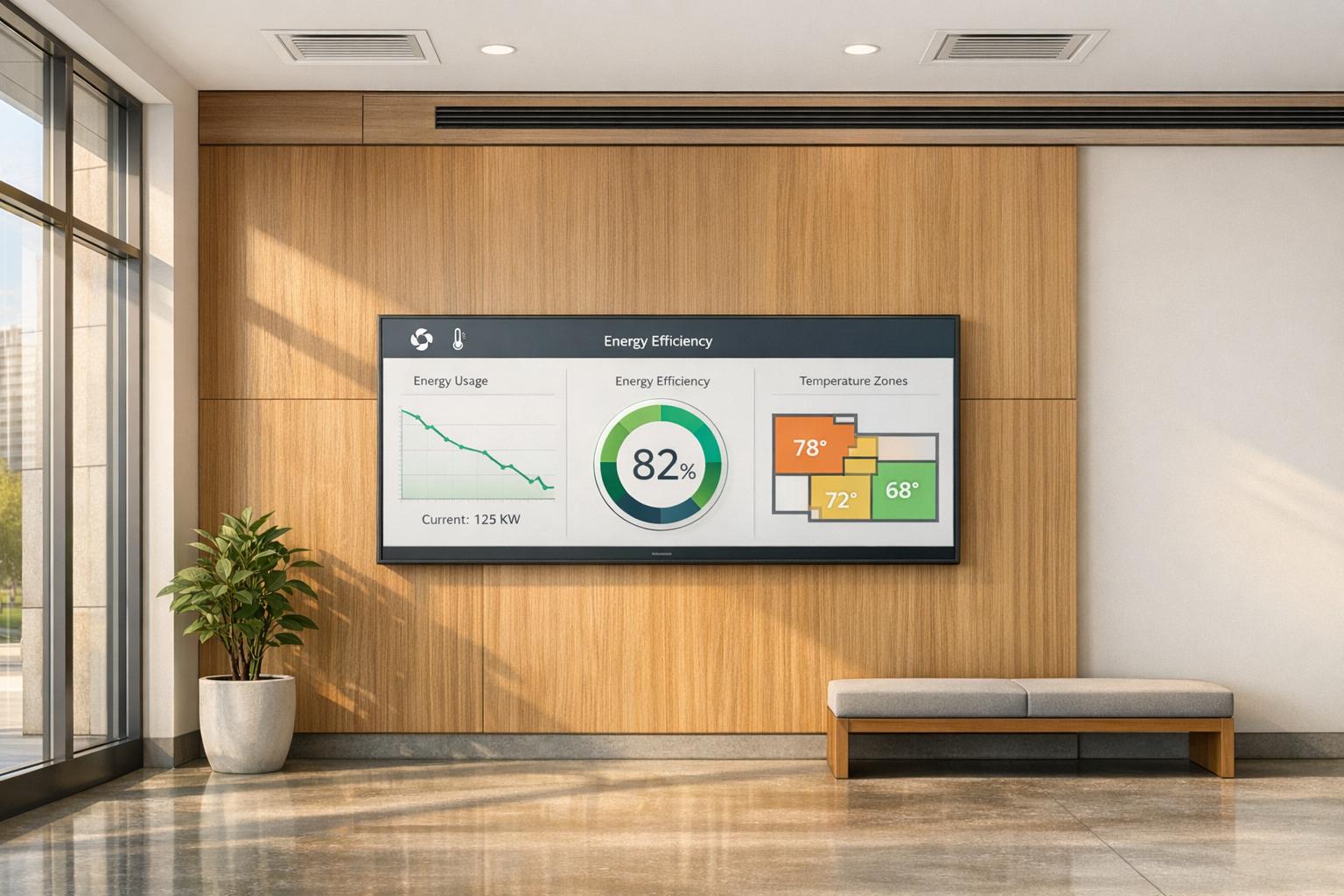
- test :
Building Automation Systems (BAS) and HVAC energy monitoring tools are transforming how buildings manage energy use. BAS centralizes control of systems like HVAC, lighting, and security, using real-time data to optimize operations. Meanwhile, HVAC energy monitoring tools focus on detailed insights into HVAC performance, enabling precise adjustments and maintenance. Together, these systems can reduce energy consumption by up to 30%, cut maintenance costs, and extend equipment lifespan.
Key takeaways:
- BAS automates and integrates building systems, offering centralized control and significant energy savings.
- HVAC monitoring tools provide real-time data for targeted energy management and fault detection.
- Both approaches help organizations like schools and healthcare facilities lower costs and improve efficiency.
For public facilities in Texas, companies like E3 Design-Build Contractor offer tailored solutions that combine BAS and HVAC monitoring for optimal results.
SBA 538: BAS Fundamentals for HVAC Mechanics
sbb-itb-034f8e1
1. Building Automation Systems (BAS)
A Building Automation System (BAS) brings centralized control to HVAC, lighting, and security systems, all through a single interface. Unlike the simpler thermostats found in single-family homes, BAS is designed for managing entire commercial buildings or even multi-site campuses. It offers advanced tools like real-time performance tracking, diagnostics, and automation.
Energy Efficiency
BAS stands out for its ability to cut energy waste through intelligent automation. It uses features like occupancy-based adjustments and demand-controlled ventilation to optimize operations based on real-time conditions. Centralized dashboards make it easier for facility teams to spot and address energy inefficiencies immediately.
For example, real-time fault detection can slash unplanned downtime by up to 50%. Demand-based reset strategies, which adjust chilled water temperatures based on actual building needs, can bring down chiller energy use by 8% to 20% [1]. A great case in point is the University of Birmingham, where Trevor Payne, Director of Estates, implemented Schneider Electric‘s EcoStruxure system across 200+ buildings with 1,200 connected points. This setup offered 24/7 remote monitoring and expert troubleshooting, helping to prevent unexpected downtime [1].
"Using Schneider’s Power Monitoring Expert software has granted us insight into energy usage and power quality in real-time. From this, we are able to make informed decisions that improve performance and drive sustainability."
– Trevor Payne, Director of Estates, University of Birmingham [1]
Beyond energy savings, BAS improves system communication, creating opportunities for unified control.
Integration Capabilities
Modern BAS platforms use open communication protocols like BACnet and Modbus to connect devices from various manufacturers without needing custom integrations. BACnet, which accounts for around 80% of the North American BAS market, excels in enabling multi-vendor compatibility. For facilities with older systems, multi-protocol gateways and proprietary drivers help bridge the gap between legacy equipment and newer controllers.
Integration goes beyond HVAC, combining data streams from lighting, security, electrical meters, and access control into a single interface. With standard REST APIs, BAS data can link to cloud platforms and Computerized Maintenance Management Systems (CMMS). This allows for automated work order generation when thresholds are breached. It also enables load shedding of non-essential equipment during peak demand, helping to avoid high energy charges while maintaining comfort in critical areas.
This level of integration ensures flexibility and supports future expansions, which are crucial for evolving facility needs.
Scalability
BAS platforms are built with modular designs, allowing facilities to start with basic HVAC control and expand later to include systems like fire safety, security, and power management. Cloud-based solutions make it possible to manage multiple remote sites from one location – an advantage for school districts, municipalities, and healthcare systems with distributed campuses. For instance, IBM TRIRIGA processed 65,000 work orders annually and delivered space utilization insights 99% faster than traditional methods, saving one enterprise US$30 million in costs [4].
Scalability also depends on choosing systems that support open protocols, avoiding vendor lock-in. Wireless sensor networks add even more flexibility, extending monitoring capabilities to areas where traditional cabling isn’t feasible. This allows facilities to expand without major construction disruptions. For Texas public entities, E3 Design-Build Contractor offers BAS solutions tailored to the needs of school districts, municipalities, and healthcare facilities.
These scalable features make BAS a smart choice for long-term cost management.
Cost Effectiveness
The financial benefits of BAS lie in reducing operating costs and extending equipment lifespans. Automated scheduling eliminates energy waste from systems running 24/7, while predictive maintenance identifies issues before they lead to expensive repairs. Remote access features allow building engineers to oversee larger areas with fewer staff, responding to problems without needing to be on-site around the clock.
Modular designs also allow phased rollouts, lowering upfront costs. Open protocols ensure competitive bidding for system components, avoiding the expense of being tied to a single vendor. The result? Lower energy bills, reduced maintenance expenses, and fewer disruptions. These savings can then be redirected toward key priorities in education, healthcare, or public services, aligning with the broader goal of efficient and integrated facility management.
2. HVAC Energy Monitoring Tools
HVAC energy monitoring tools take the centralized control of BAS a step further by offering detailed, real-time insights specific to HVAC systems. While BAS oversees multiple building systems, these tools zoom in on HVAC performance and energy usage, providing facility managers with actionable data. Using sensors, they continuously measure factors like temperature, humidity, air quality, and occupancy, automatically adjusting energy consumption to match actual needs [7]. Let’s break down how these tools improve energy efficiency, integrate with existing systems, scale to meet facility demands, and deliver cost benefits.
Energy Efficiency
These monitoring tools excel at saving energy through real-time adaptive controls and predictive maintenance. Sensors detect occupancy and air quality, enabling demand-controlled ventilation (DCV) that adjusts airflow based on actual conditions. This not only ensures efficient operation but also helps identify inefficiencies early, preventing energy waste and expensive breakdowns [7][9]. For example, smart scheduling ensures HVAC systems operate at full capacity during busy hours and switch to energy-saving modes during quieter times. Predictive maintenance can cut maintenance costs by up to 20% and reduce equipment downtime by 50% [9].
"Building automation systems (BAS) are increasingly common in a variety of environments to make HVAC systems as efficient as possible and reduce the need for in-person monitoring of pressure in each area."
– Meghan Kelley, Setra Systems [8]
Buildings equipped with these tools can reduce energy consumption by 30% to 50% compared to traditional systems. Businesses using them often see annual energy cost savings of 10% to 30% [9][10].
Integration Capabilities
HVAC monitoring tools seamlessly integrate with BAS using standard communication protocols, creating a network where sensors and systems work together. IoT gateways play a significant role here, connecting devices like BACnet, Modbus, Zigbee, and LoRaWAN into a unified system. This setup allows older HVAC sensors to function alongside modern technology, improving performance tracking without the need for a complete system overhaul [1][2].
Integration enables real-time feedback loops. For instance, data from sensors monitoring occupancy, CO₂ levels, and pressure can automatically adjust HVAC settings to optimize performance [1][3]. Advanced tools also connect to Computerized Maintenance Management Systems (CMMS), translating sensor-detected faults into actionable work orders with diagnostic details [1]. Additionally, edge computing processes data locally, minimizing latency and ensuring smooth performance even if network connectivity falters [3].
These tools can manage a variety of equipment, including chillers, boilers, air handling units (AHUs), rooftop units (RTUs), fan coil units (FCUs), and heat pump units (HPUs) [10]. Transducers and power meters provide real-time feedback to meet energy efficiency and regulatory goals [8].
Scalability
HVAC monitoring tools are designed to scale effortlessly, whether for a single building or an entire portfolio of sites. Unlike BAS, which oversees multiple building systems, these tools focus solely on HVAC performance, making them ideal for targeted energy management. They allow facility managers to monitor HVAC systems across multiple locations from a single dashboard, simplifying energy management for large portfolios [4][9][10].
Wireless mesh networks, like those using LoRaWAN or Zigbee, make scaling even easier. These networks eliminate the need for costly wiring, making them particularly useful for retrofitting older buildings [9]. Scalable systems can also lower future upgrade costs by up to 25% compared to less adaptable options [9]. For example, in Texas, public entities such as school districts and healthcare systems have turned to E3 Design-Build Contractor for HVAC monitoring solutions tailored to their needs.
Cost Effectiveness
The financial benefits of HVAC monitoring tools are clear. They help reduce operating costs, extend the life of equipment, and offer a quick return on investment through lower energy bills and reduced maintenance expenses. Automated data collection eliminates the need for manual readings, while real-time alerts flag inefficiencies or potential issues before they escalate into costly problems [7][10]. Facilities can also optimize energy use by scaling back heating, cooling, or lighting in underutilized areas [7].
IoT-enabled monitoring increases operational efficiency by an average of 20% [9]. For a commercial building of approximately 107,600 square feet with a central chiller plant and 8 to 12 AHUs, the initial hardware and connectivity investment ranges from $15,000 to $45,000. The return on investment typically occurs within 12 to 18 months [1].
Advantages and Disadvantages
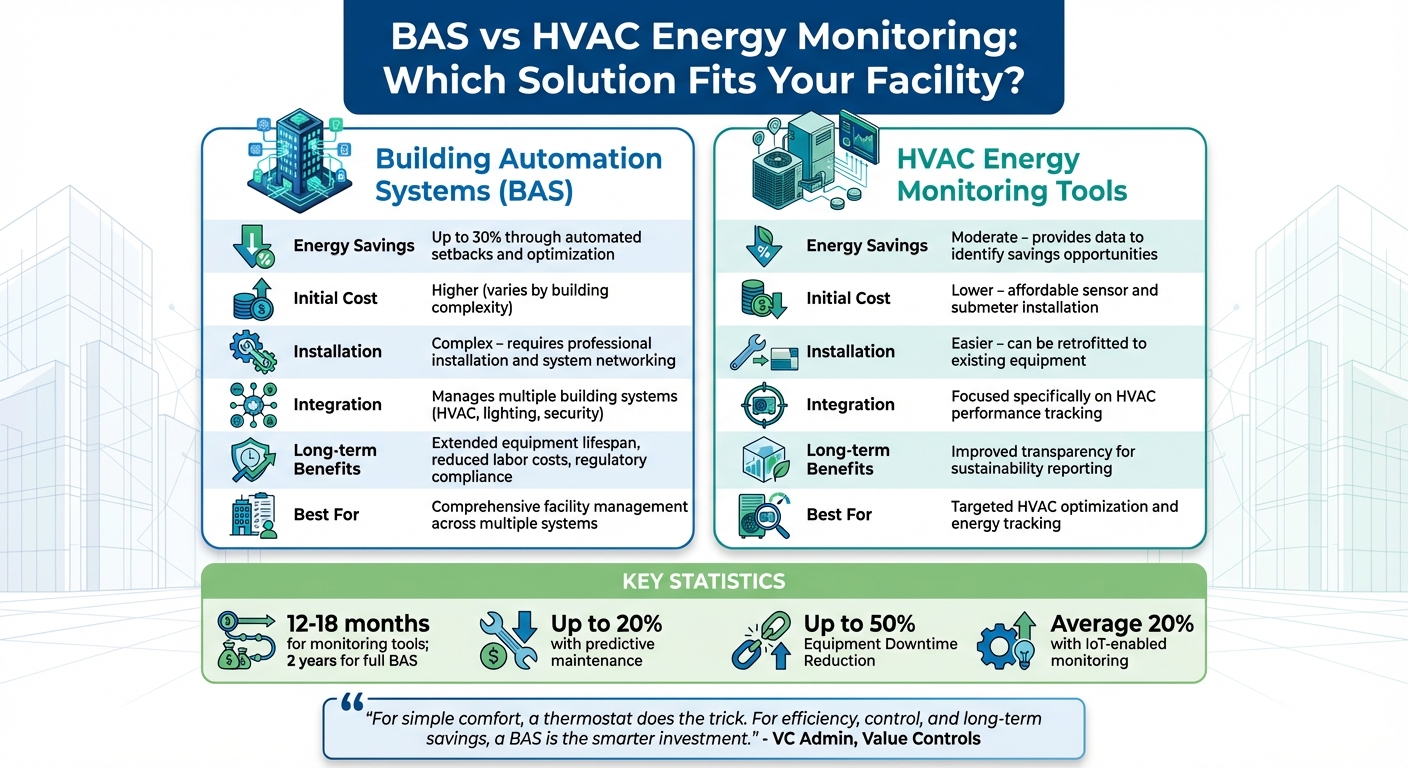
BAS vs HVAC Energy Monitoring: Features, Costs, and Benefits Comparison
BAS and HVAC monitoring each come with their own set of strengths and challenges. Knowing these can help you decide which option aligns better with your building’s needs and financial constraints.
BAS stands out for its all-encompassing control and automation. It consolidates the management of multiple systems, potentially delivering up to 30% energy savings through automation and predictive maintenance, which also extends the life of equipment [10]. However, the trade-off is a higher upfront cost and a more complex installation process, often requiring professional expertise to integrate hardware and software across the building’s network [6].
HVAC monitoring tools, on the other hand, provide a more focused and accessible solution. They are easier to install, especially as retrofits for existing systems, and come with lower initial costs, thanks to their reliance on sensors and submeters. That said, their savings potential is more modest compared to BAS, and they may require additional manual adjustments to achieve optimal results [5].
"For simple comfort, a thermostat does the trick. For efficiency, control, and long-term savings, a BAS is the smarter investment." – VC Admin, Value Controls [5]
Here’s a quick comparison of the two approaches:
| Feature | Building Automation Systems (BAS) | HVAC Energy Monitoring Tools |
|---|---|---|
| Energy Savings | High (up to 30%) through automated setbacks and optimization [10] | Moderate; provides data to identify savings opportunities |
| Initial Cost | Higher; varies by building complexity [6] | Lower; affordable sensor and submeter installation |
| Integration Ease | Complex; requires professional installation and system networking | Easier; can be retrofitted to existing equipment |
| Long-term Benefits | Extended equipment lifespan, reduced labor, regulatory compliance [6] | Improved transparency for sustainability reporting |
These considerations are essential for public organizations aiming to implement effective energy management systems. Striking the right balance between BAS and HVAC monitoring can lead to a well-rounded, energy-efficient strategy. For public entities in Texas, such as school districts and healthcare facilities, E3 Design-Build Contractor provides customized solutions that weigh both options, ensuring energy efficiency without exceeding budget constraints.
Conclusion
Bringing together BAS (Building Automation Systems) and HVAC energy monitoring creates a powerful approach to managing energy use. BAS offers centralized control and automation across building systems, while energy monitoring provides the real-time data needed to fine-tune operations and reveal inefficiencies. Together, they form a dynamic system where automated controls are continually improved based on actual performance, cutting energy use by as much as 30% and extending the life of equipment [10].
This integration does more than just save energy – it boosts overall operational efficiency for public facilities. For organizations like school districts, healthcare facilities, and municipalities, the advantages go beyond cost savings. Features like demand control ventilation adjust airflow based on occupancy, reducing waste in unused spaces. Additionally, participating in demand response programs can generate revenue to help offset system costs. In fact, a well-implemented building management system often pays for itself within two years [11]. The labor saved by automating processes also allows facility staff to focus on more critical responsibilities.
"As energy costs rise, a well-designed BAS is not just an upgrade – it’s a necessity for any property focused on sustainability and long-term savings." – CIS Industries [7]
To maximize these benefits, public entities should start with a detailed energy audit to identify specific needs. From there, prioritizing systems with open protocols like BACnet ensures long-term adaptability. E3 Design-Build Contractor specializes in delivering these integrated solutions for public facilities in Texas. Their expertise in deep energy retrofits ensures HVAC, lighting, and automation systems work seamlessly together, creating efficient and sustainable environments that serve communities effectively.
Continuous energy management is key to sustaining these benefits. Ongoing monitoring uncovers usage trends, enabling facility managers to make informed, data-driven adjustments. This turns buildings into responsive, efficient assets – perfectly aligning with the goal of using smart automation to create cost-effective and sustainable public facilities.
FAQs
Do I need a BAS, HVAC monitoring, or both?
Whether you should invest in a Building Automation System (BAS), HVAC monitoring, or both comes down to your goals for energy efficiency and system control. A BAS streamlines and centralizes the management of building systems, helping to improve energy use and maintain comfort levels. On the other hand, HVAC monitoring focuses on tracking system performance and energy usage, making it easier to spot inefficiencies.
Using both together provides enhanced automation, deeper data insights, and improved operations – making it a smart choice for those aiming for comprehensive energy management and better system performance.
What data should HVAC monitoring track for real savings?
To make meaningful savings, HVAC monitoring needs to focus on critical data points such as energy consumption, temperature differences, airflow rates, refrigerant pressure, and runtime hours. Tracking these metrics allows you to pinpoint inefficiencies, spot potential faults, and evaluate whether the system’s performance aligns with expected benchmarks. By gathering this information, you can ensure better energy use, confirm cost savings, and meet guidelines like ASHRAE Guideline 36, which promotes optimal system performance and fault detection.
How hard is it to integrate with older equipment?
Integrating older HVAC systems with modern building automation systems (BAS) can be tricky, especially if the existing equipment lacks updated communication protocols. In many cases, retrofitting these systems involves adding hardware such as protocol converters to bridge the gap. The good news is that full replacements aren’t always necessary – partial upgrades can often do the job.
That said, evaluating the condition and compatibility of your current setup is crucial. This assessment helps determine whether integration is feasible or if replacing the equipment might be a smarter, more efficient choice in the long run.