

- test :
Cybersecurity for Building Automation Systems (BAS) is more critical than ever. With smart buildings relying on IoT and AI, the risks of cyberattacks have grown significantly. Breaches can lead to operational disruptions, data exposure, and even safety risks. In 2024, the average cost of a data breach reached $4.88 million, and organizations without incident response plans faced 58% higher costs per breach.
To protect BAS environments, focus on these key areas:
- Understand unique BAS risks: Integration of physical systems like HVAC and lighting with networks creates vulnerabilities.
- Address legacy systems: Outdated software and protocols like BACnet often lack security features.
- Adapt IT and OT security approaches: BAS prioritizes availability and safety over data confidentiality.
- Implement best practices: Establish baselines, conduct regular testing, monitor systems, and prepare incident response plans.
- Leverage technology and partnerships: Use tools like AI, network segmentation, and BACnet/SC, and work with specialized contractors.
Key takeaway: Cybersecurity in BAS isn’t static. Continuous improvement through testing, monitoring, and collaboration is essential to counter evolving threats and ensure safe, reliable building operations.
Controls Con 2024 | Cyber Security for BAS Panel
sbb-itb-034f8e1
Cybersecurity Challenges in Building Automation Systems
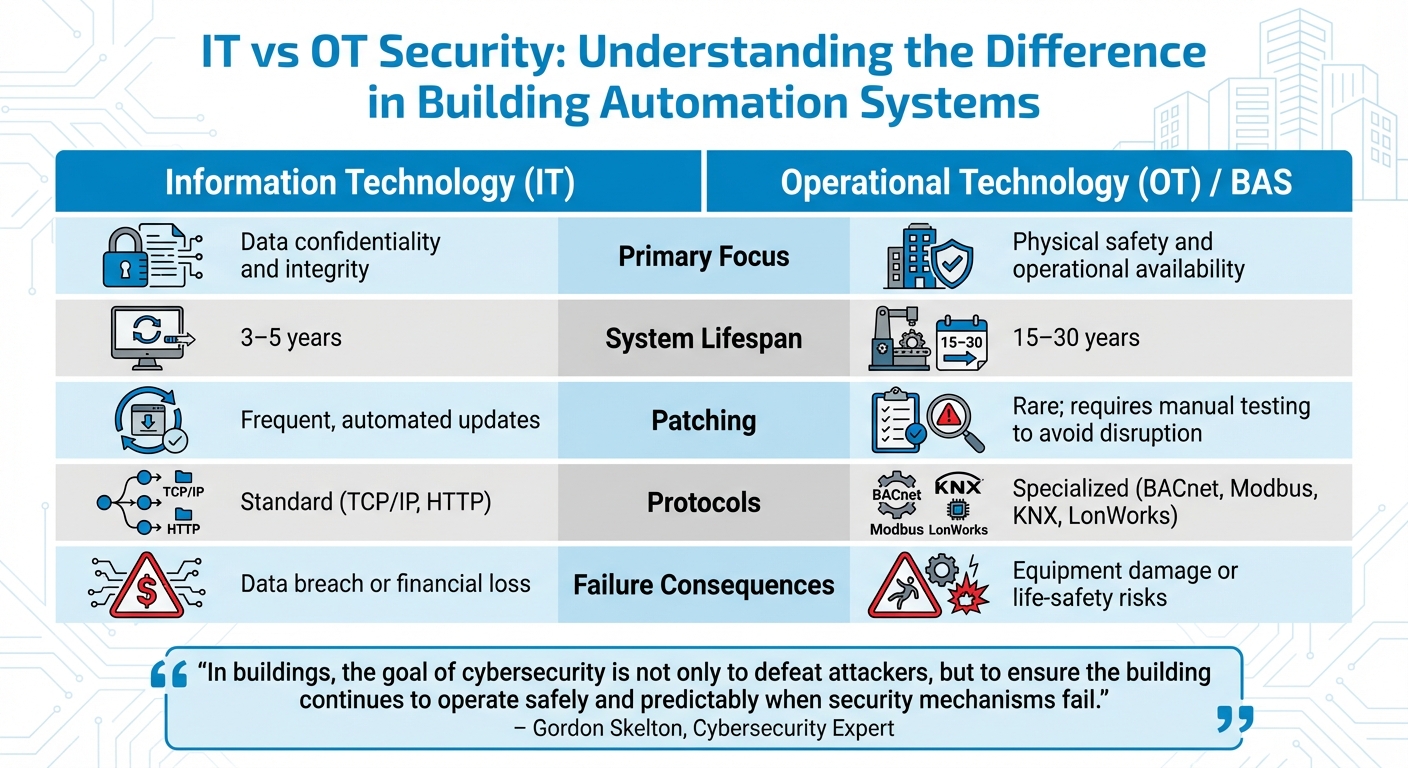
IT vs OT Security in Building Automation Systems: Key Differences
Building automation systems (BAS) face challenges that differ significantly from those in traditional IT setups. The integration of physical building controls with network infrastructure introduces vulnerabilities that attackers can exploit, leading to tangible, real-world consequences. Recognizing these challenges is critical for developing effective defenses.
How BAS Integration Creates Security Risks
BAS environments bring together systems like HVAC, lighting, access control, fire suppression, and elevators into a unified network. While this integration boosts efficiency, it also creates new attack surfaces that didn’t exist when these systems operated independently. As the Security Systems Authority explains:
The defining characteristic separating this domain from standard enterprise cybersecurity is the presence of cyber-physical coupling: a successful cyberattack can cause physical impacts [6].
The numbers speak for themselves. OT-focused cyberattacks on building systems surged by 30% year-over-year as of 2026. Alarmingly, 26% of BAS threats bypass perimeter defenses entirely by entering directly from the internet [7]. A high-profile example is the 2013 Target Corporation breach, where attackers exploited credentials stolen from a third-party HVAC vendor. This led to the compromise of 40 million credit and debit card records [7].
The transition to IP-based networks has amplified these risks. Legacy protocols like BACnet, Modbus, and LonWorks were designed for isolated systems, not the internet-connected infrastructure we see today. Despite BACnet controlling over 60% of the building automation market, many devices using it lack basic security features like authentication and encryption [7]. This means any client on the network can manipulate device properties, leaving systems dangerously exposed.
Third-party vendor access adds another layer of vulnerability. Maintenance for HVAC systems, elevators, and other equipment often requires remote access. These connections are frequently unmonitored and permanent, making them easy targets for attackers [6][7]. A 2020 CISA alert (AA20-205A) highlighted how adversaries exploit these pathways, even in systems operators mistakenly believe are isolated [6].
These integration issues directly tie into the risks posed by outdated system technologies.
Security Risks from Legacy Systems
BAS components often have lifespans of 10 to 30 years [8], meaning many systems operate on unsupported software. This creates dangerous gaps where critical building systems are vulnerable to unauthorized access because they no longer receive updates or security patches.
Marc Bertolin, Channel Sales Manager at Johnson Controls, underscores this concern:
Software that no longer receives security patches and updates opens your system to unauthorized access [8].
Many legacy systems still rely on outdated operating systems like older versions of Microsoft Windows, which are no longer supported. Upgrading these systems is no simple task – compatibility issues between old software and modern hardware can lead to instability or even complete failures. Adding to the challenge, technicians with expertise in these older systems are becoming harder to find, and replacement parts are both scarce and expensive.
Beyond cybersecurity risks, legacy systems also create operational headaches. They may behave unpredictably, consume more energy, and lack support for modern features. Additionally, they often fail to align with current IT policies or meet evolving regulatory requirements [8].
These challenges highlight why BAS security requires a distinct approach compared to traditional IT security.
Differences Between OT and IT Security
Securing BAS environments involves a fundamentally different strategy than traditional IT security. The goals of each differ: IT security prioritizes protecting data, while OT security focuses on safeguarding physical processes, equipment, and occupant safety [9][10].
The table below outlines some of the key distinctions:
| Feature | Information Technology (IT) | Operational Technology (OT) / BAS |
|---|---|---|
| Primary Focus | Data confidentiality and integrity | Physical safety and operational availability |
| System Lifespan | 3–5 years | 15–30 years |
| Patching | Frequent, automated updates | Rare; requires manual testing to avoid disruption |
| Protocols | Standard (TCP/IP, HTTP) | Specialized (BACnet, Modbus, KNX, LonWorks) |
| Failure Consequences | Data breach or financial loss | Equipment damage or life-safety risks |
Gordon Skelton, a cybersecurity expert, emphasizes this critical difference:
In buildings, the goal of cybersecurity is not only to defeat attackers, but to ensure the building continues to operate safely and predictably when security mechanisms fail [10].
Standard IT tools often do more harm than good in BAS environments. For example, active vulnerability scanners can crash controllers or cause them to enter fault states. Similarly, encryption or frequent re-authentication may disrupt time-sensitive control logic if certificates expire or if controllers with limited resources buckle under the load [10].
Mirel Sehic, Global Director of Cybersecurity at Honeywell Building Technologies, highlights another challenge:
Operational technology (OT) systems… are often neglected by IT departments, receiving less than their share of monitoring and maintenance [9].
This lack of attention leaves BAS systems vulnerable. Facility management teams may not have the cybersecurity expertise needed, while IT departments often fail to grasp the operational and physical consequences of BAS security failures.
Best Practices for Continuous Improvement in BAS Cybersecurity
Continuous improvement plays a key role in keeping building automation systems (BAS) secure. With cyber threats evolving daily, a structured approach is necessary to stay ahead. Angela Gelnaw, Director of Ecosystem Strategy at Bitsight, emphasizes this point:
Continuously monitoring an organization’s security posture is just the start in building a mature security performance management program. Businesses need to go beyond continuous monitoring to really be effective – there needs to be a process of continuous improvement. [11]
The numbers highlight the urgency. By 2025, cybercrime is expected to cost the global economy $10.5 trillion annually, a sharp rise from $3 trillion in 2015. In 2023 alone, over 23,000 security incidents were reported, leading to 5,200 confirmed data breaches [12]. For BAS environments, the stakes are even higher, as breaches can directly impact physical safety and building operations. To adapt to this ever-changing threat landscape, organizations can follow these best practices to set a strong foundation, test defenses, and maintain vigilance.
How to Establish a Security Baseline
The first step is understanding your current security posture. This involves cataloging assets and mapping data flows. Document every component in your BAS – controllers, sensors, workstations, network switches, and third-party access points. Visibility is essential; you can’t secure what you don’t know exists.
Conduct a vulnerability assessment to pinpoint gaps like outdated software, unsecured file sharing, or unencrypted communication. Identify potential risk scenarios – ransomware attacks, insider threats, or compromised IoT devices – and tailor your mitigation strategies accordingly.
Align your security goals with established frameworks such as NIST or ISO 27001. These frameworks provide benchmarks for critical controls and help measure progress. For example, track metrics like the percentage of critical patches applied within a set timeframe (e.g., 72 hours) or the number of unpatched systems in your environment [12].
Document standard operating procedures for secure daily activities, including password management, access control, and incident reporting. Clear standards make it easier to detect deviations.
Treat your baseline as a living framework. Use the Plan-Do-Check-Act (PDCA) cycle to continually refine your measures, and consider hosting Kaizen workshops. These short, collaborative sessions bring together IT, facility management, and operations teams to uncover hidden vulnerabilities. When issues arise, techniques like the "5 Whys" or Fishbone Diagrams can help identify root causes.
Once your baseline is set, rigorous testing ensures its effectiveness.
Regular Testing and Validation Methods
A security baseline is only useful if it’s tested regularly. Validation not only identifies vulnerabilities but also ensures your defenses keep pace with emerging threats.
Iterative testing cycles are crucial for refining detection capabilities and updating rule sets. Simulations and tabletop exercises can expose weaknesses in incident response protocols, helping reduce Mean Time to Respond (MTTR). For instance, a BAS manufacturer reported a field failure rate of less than 1 in 16,000 products due to thorough testing [1].
Testing can uncover vulnerabilities like unprotected IoT devices, outdated firmware, or misconfigured access controls. Network segmentation is one solution – isolating IoT devices on separate networks can limit the impact of breaches.
Adopt a risk-based patching schedule, prioritizing high-severity patches within 72 hours of release [12]. Automate repetitive tasks like patch scanning and log ingestion with Security Orchestration, Automation, and Response (SOAR) tools.
| CI Methodology | Application in BAS Cybersecurity | Key Benefit |
|---|---|---|
| PDCA | Continuous planning, testing, and improvement of controls | Adapts to evolving threats |
| Kaizen | Collaborative workshops to find vulnerabilities | Identifies hidden risks like poor access controls |
| Agile | Sprint-based updates to detection rules and intelligence | Quick response to new threats |
| DMAIC | Data-driven refinement of patch management | Reduces exposure to known risks |
Once testing is in place, continuous monitoring becomes the next critical step.
Monitoring and Incident Response Readiness
Effective BAS cybersecurity relies on continuous monitoring. Real-time visibility helps detect anomalies early and respond quickly to prevent escalation.
Layered detection tools, such as endpoint monitoring, firewalls, intrusion detection systems (IDS), and security incident event management (SIEM) solutions, provide comprehensive coverage. Automated alerts from intrusion detection and prevention systems (IDPS), antivirus software, and log analyzers further reduce response times.
Despite these tools, many organizations struggle with incident response readiness. Less than half of companies test their incident response plans annually, and about 20% lack a formal plan altogether [14]. To address this, adopt a recognized incident response framework that includes preparation, detection, containment, eradication, recovery, and post-incident review.
Form a multidisciplinary incident response team with representatives from IT, management, legal, HR, and communications. Dedicated communication channels like war rooms, secure messaging platforms, and cloud-hosted backups can streamline coordination during a crisis.
Sabrina Pagnotta, Senior Content Marketing Manager at Bitsight, advises:
Preparation is key to an effective response. Start by developing a policy for how you will manage your incident response, what actions must be prioritized, and who will lead incident handling. [13]
Conduct monthly drills to simulate various threat scenarios, and use tabletop exercises to evaluate readiness. After each drill or incident, hold "blameless" post-mortem meetings to identify lessons learned and refine your processes. As Adonis Partners notes: "RCA turns one incident into a learning opportunity for broader risk prevention" [12].
Prioritize critical assets by classifying incidents based on their functional impact and the sensitivity of affected data [14]. Publicly traded companies, for instance, must disclose material cybersecurity incidents within four business days under U.S. SEC rules, highlighting the need for rapid assessment and clear communication [13]. Simplify executive reporting by designating a leader, such as a Chief Information Security Officer (CISO), to deliver concise, non-technical updates to senior management.
Using Technology and Partnerships to Strengthen BAS Security
To safeguard Building Automation Systems (BAS), building owners need to focus on two key areas: advanced security tools and strategic partnerships. The best results come from combining cutting-edge technology with expert advice to build defenses that can adapt to new threats.
Advanced Security Tools for BAS Environments
Modern BAS setups face challenges that differ from traditional IT systems. While IT typically emphasizes data confidentiality, BAS prioritizes integrity (ensuring commands are accurate) and availability (keeping systems accessible when needed) [5]. This makes tailored security tools essential.
One of the most effective defenses is network segmentation, which separates BAS and IoT devices from critical business systems. This approach limits the fallout from breaches. A well-known example is a major retail chain’s data breach, where hackers accessed customer records through a vulnerable HVAC system [1]. As Phil Zito from Smart Buildings Academy explains:
Cybersecurity remains critical as BAS shifts to IP-based networks and edge computing. [5]
Newer protocols like BACnet/SC (Secure Connect) have stepped up to address vulnerabilities in older systems. By enabling encrypted communication and device authentication, they protect BAS networks as they transition to IP-enabled devices.
AI and machine learning tools are also game-changers. These technologies can detect anomalies and predict maintenance needs by analyzing system behavior and occupancy patterns. They integrate seamlessly with BAS protocols, allowing for real-time threat detection. Automated tools, such as Security Orchestration, Automation, and Response (SOAR) platforms, can contain threats up to four times faster than manual methods [3].
Logical access controls add another layer of security. Multi-factor authentication (MFA), role-based access control (RBAC), and session locks ensure that only authorized users can make changes. Employing the "least privilege" principle – granting users only the access they need – reduces the risk of unauthorized actions [5]. On the physical side, measures like protected conduits for RS485 communication lines help prevent tampering or eavesdropping [5].
While these tools provide robust technical defenses, they require expert implementation to be fully effective.
Working with Specialized Contractors
Pairing advanced tools with skilled contractors ensures BAS security measures stay effective as threats evolve. Technology alone isn’t enough; expert contractors help translate these tools into comprehensive security solutions. For example, firms like E3 Design-Build Contractor specialize in integrating security measures into BAS while maintaining energy efficiency and operational performance.
This expertise is particularly critical for public organizations – such as schools, hospitals, and municipal buildings – that must balance tight budgets with strict security requirements. Specialized contractors are adept at navigating frameworks like NIST 800-53 and Unified Facilities Criteria (UFC), which classify risks and outline security controls [5].
Functional Devices, Inc. highlights the importance of collaboration:
Close collaboration between facilities managers and IT professionals is essential to develop an integrated approach to cybersecurity. [1]
Such teamwork ensures that BAS security aligns with broader corporate data protection goals while addressing the unique needs of physical systems.
Experienced contractors offer a range of services, including forensic analysis, coordinated incident response, and ongoing training with simulations and phishing drills [4][2]. Organizations without a tested incident response plan can face breach costs that are 58% higher than those with established protocols [3].
When selecting contractors, look for those capable of implementing modern security features like BACnet/SC, session locks, and device-to-device authentication. They should also provide 24/7 support and cloud-hosted incident response plans that remain operational during outages [14]. Post-incident analysis and debriefings are equally important for improving security over time [14][4].
Measuring Success and Responding to New Threats
Key Performance Indicators for BAS Security
To keep building automation system (BAS) security on track, measuring performance is essential. Metrics like Mean Time to Detect (MTTD), Mean Time to Contain (MTTC), and Mean Time to Resolve (MTTR) provide critical insights into how well your security measures are working. As SecurityScorecard points out:
You can’t manage what you can’t measure. With cyber threats constantly evolving and becoming harder to detect, you need to have measures in place to assess the effectiveness of your cybersecurity programs. [15]
- MTTD: Tracks how fast your team identifies potential security incidents.
- MTTC: Measures how quickly threats are isolated to prevent further damage.
- MTTR: Reflects the time it takes to eliminate a threat and restore normal operations.
These response times are just the beginning. Monitoring your Vulnerability Patching Rate – the time it takes to apply critical updates – is equally vital. Cybercriminals often exploit the delay between a patch release and its implementation [15]. Another key metric is your Authentication Success Rate, which evaluates whether access controls like multi-factor authentication (MFA) and role-based permissions are functioning as intended [15].
Interestingly, nearly 98% of organizations have dealt with third-party breaches in the past two years, underscoring the importance of securing external partnerships [15].
For BAS environments, metrics like System Availability and Integrity take center stage. Unlike traditional IT systems, BAS prioritizes ensuring that commands are accurate and devices remain accessible [5]. Additionally, physical security compliance matters – keeping RS485 communication lines secure helps prevent tampering [5].
While these metrics are essential for tracking performance, staying ahead of new threats is just as important.
Staying Current with Emerging Cyber Threats
The landscape of cyber threats is always shifting, and modern BAS environments face increasingly sophisticated risks. Phil Zito from Smart Buildings Academy highlights this ongoing evolution:
Cybersecurity is going to remain and become ever more important as we further distance ourselves from serial networks, moving towards IP networks, moving towards more compete at the edge. [5]
To keep up, organizations should lean on established frameworks like the Risk Management Framework (RMF). This six-step process – Categorize, Select, Implement, Assess, Authorize, and Monitor – ensures that security controls remain effective even as new vulnerabilities emerge [5]. Additionally, frameworks like NIST 800-53 provide detailed guidelines for implementing and maintaining security controls [5].
Collaboration with equipment manufacturers and distributors is another critical step. Understanding the security features of your hardware, such as BACnet/SC authentication, can help bolster your defenses. Simple measures like automated session locks, timeouts for unattended terminals, and alerts for failed login attempts can also make a big difference in detecting unauthorized access attempts [5].
Finally, don’t overlook the importance of regular firmware updates. Outdated software is one of the most common entry points for cyberattacks, making it crucial to stay current [1].
Conclusion: Building Secure and Resilient BAS Infrastructure
Building automation systems (BAS) have moved far beyond isolated setups. As these systems transition from traditional serial networks to IP-enabled devices and edge computing [5], their exposure to cyber threats has grown significantly. This shift makes cybersecurity a continuous and dynamic process – one that revolves around preparation, detection, containment, eradication, recovery, and learning from past incidents [3][2].
By 2024, the global average cost of a data breach hit $4.88 million [3]. Alarmingly, about 68% of these breaches were linked to human errors, such as phishing attacks and system misconfigurations [3]. These numbers highlight the importance of regular security drills, annual reviews of response plans, and strong collaboration across teams like IT, legal, HR, and security.
For BAS, security priorities differ from those in IT. While IT tends to focus on confidentiality, BAS requires a stronger emphasis on integrity (ensuring commands like chiller setpoints are accurate) and availability (keeping systems operational for daily use) [5]. Addressing these priorities involves a mix of logical controls – like encryption and role-based access – and physical safeguards, such as protecting RS485 trunks with conduits to prevent tampering [5]. This unique focus demands a well-structured security strategy tailored specifically to BAS.
Frameworks like the RMF provide a solid foundation for building these defenses. Partnering with experts, such as E3 Design-Build Contractor, can further strengthen your approach. E3 specializes in integrating energy-efficient and secure BAS solutions, ensuring compliance with technical and regulatory standards while addressing specific needs [4][5]. Their expertise helps you create a layered security approach that evolves with emerging threats.
Shockingly, only 30% of companies consistently test their incident response plans [3]. Don’t let your organization fall into the 70% that neglects this critical step. By focusing on best practices – establishing baselines, automating threat detection, running regular drills, and committing to continuous improvement – you can develop a BAS infrastructure that stands strong against today’s challenges and tomorrow’s uncertainties.
FAQs
What are the biggest cybersecurity risks unique to BAS?
Building Automation Systems (BAS) face growing cybersecurity challenges, largely due to their increasing integration with IoT devices. This connectivity significantly broadens potential vulnerabilities, creating more opportunities for cyberattacks. These exploits can result in unauthorized access, operational disruptions, or even physical damage, especially in critical facilities where BAS plays a vital role.
On top of this, the complexity of BAS protocols makes it harder to monitor systems and detect threats effectively. This highlights the importance of implementing strong security measures to counter evolving risks and protect these systems from potential breaches.
How can we secure legacy BAS devices we can’t replace yet?
To protect older Building Automation System (BAS) devices that aren’t ready for replacement, it’s important to adopt a multi-layered defense strategy. Start by using reliable tools to routinely scan for vulnerabilities. Limit access by implementing network segmentation, which helps keep these devices separate from critical IT systems.
On top of that, enforce strict access controls, actively monitor device activity, and apply any available security patches. Even for outdated or unsupported devices, these steps can help minimize potential risks and improve overall security.
What should a BAS incident response plan include?
A solid incident response plan for a Building Automation System (BAS) is essential for dealing with potential cybersecurity threats effectively. Here’s what it should include:
- Clear Communication Protocols: Establish a chain of communication to ensure everyone knows their role during an incident. This avoids confusion and speeds up response time.
- Defined Roles and Responsibilities: Assign specific tasks to team members so that each person knows exactly what to do when a threat arises.
- System Isolation Procedures: Create a plan for quickly isolating affected systems to prevent the threat from spreading further.
- Recovery Strategies: Outline steps to restore operations and minimize downtime once the threat is neutralized.
Regular updates and testing of the plan are equally important to ensure it remains effective against evolving threats. It’s also crucial to address vulnerabilities related to IoT and AI technologies, as these can be entry points for cyberattacks. By doing so, you can better protect sensitive data and maintain operational continuity.