

- test :
When upgrading energy systems, the choice between retrofitting and replacing depends on cost, equipment condition, and long-term goals. Here’s the breakdown:
- Retrofitting adds new components to existing systems, reducing costs and downtime. Ideal for equipment under 15 years old in good condition, it can extend system life by 5–10 years and save 15–30% on energy with a 2–5 year payback.
- Replacing involves installing entirely new systems, offering higher efficiency (30–50% savings) and longer lifespans (15–25 years). Best for outdated systems over 15–20 years old or those failing to meet energy standards.
Quick Comparison
| Criteria | Retrofitting | Replacing |
|---|---|---|
| Cost | Lower upfront ($50K avg) | Higher upfront ($500K+) |
| Energy Savings | 15–30% | 30–50%+ |
| Payback Period | 2–5 years | 5–10 years |
| System Lifespan | +5–10 years | 15–25 years |
| Disruption | Minimal | Higher |
Tip: Retrofitting is better for quick upgrades on a budget, while replacing is a long-term investment for maximum efficiency.
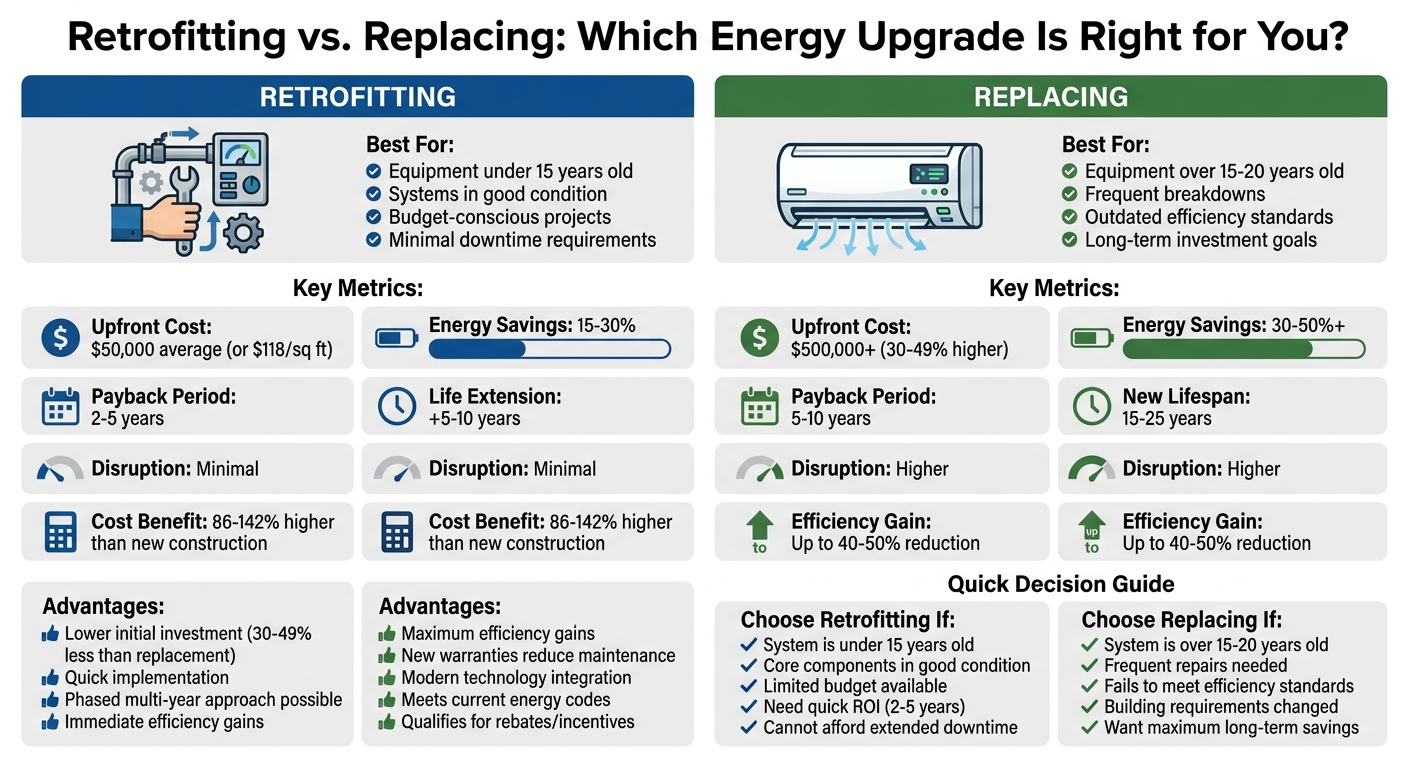
Retrofitting vs Replacing Energy Systems: Cost and Benefits Comparison
Avoid HVAC Downtime: Why It’s Time to Retrofit or Replace Aging VFDs
sbb-itb-034f8e1
Factors to Consider When Choosing Between Retrofitting and Replacing
Deciding whether to retrofit or replace an HVAC system involves weighing factors like the system’s age, maintenance history, budget, and operational requirements. Systems under 10 years old often benefit from retrofitting, while those over 15–20 years typically lean toward replacement. These considerations not only affect costs but also determine how well the system aligns with modern energy standards.
Frequent maintenance issues and rising costs for outdated parts can make ongoing repairs impractical. Additionally, changes in how a building is used – such as converting spaces, increasing occupancy, or adding heat-producing equipment – can strain systems that weren’t designed for such demands.
Budget is another key factor. Retrofitting generally costs less upfront and involves minimal downtime, making it appealing for those with limited funds or where extended outages are not feasible. On the other hand, replacement requires a larger initial investment but offers a longer operational life – typically 15–25 years compared to the 5–10 years gained through retrofitting [3]. As HVAC consultant Chaz puts it:
Retrofitting is ideal when your system has good bones and only needs a performance boost. It’s often the budget-friendly choice in the short term [3].
Compatibility with modern technology is also critical. If existing hardware can support updates like variable speed drives, smart thermostats, or integration with building management systems, retrofitting can be a strong option. However, if the system is too outdated to meet current energy regulations or achieve certifications like LEED or WELL, a full replacement may be necessary.
These factors help guide whether to enhance an existing system or replace it entirely.
When Retrofitting Makes Sense
Retrofitting works best when the system’s core components – like ductwork, piping, and main equipment – are still in good condition. Systems between 10 and 15 years old with minimal repair histories are ideal candidates.
This option is especially useful for facilities that can’t afford prolonged downtime. Schools, for instance, need functioning HVAC systems during the academic year, and healthcare facilities require uninterrupted climate control. Retrofitting allows for upgrades with minimal disruption, extending the system’s life by 5–10 years [3].
It’s also a practical choice if the current system can support modern upgrades. Adding features like variable frequency drives, smart thermostats, or integration with automation systems can improve efficiency without the cost of a full replacement. However, a structural audit is essential to ensure that key components are still reliable – if major parts are failing, retrofitting may not be worth the investment.
If these conditions aren’t met, a complete replacement may be the smarter path.
When Replacing Makes Sense
Replacement is often the better choice for systems older than 15–20 years, especially when newer technology offers much better performance. Frequent breakdowns, high repair costs, and the difficulty of finding parts all signal that patching the system is no longer cost-effective [3].
Older systems that fail to meet efficiency standards – like SEER or IEER ratings – or don’t qualify for green certifications such as LEED or WELL often require replacement. Upgrading to a new system may also be necessary to take advantage of government rebates, tax incentives, or utility programs tied to high-efficiency installations.
If building requirements have changed – whether due to increased occupancy, repurposed spaces, or added heat-generating equipment – the existing system may no longer be adequate. A new system designed to meet current load and zoning needs can resolve ongoing comfort and efficiency issues. For public facilities, replacement ensures long-term reliability, compliance with updated energy standards, and 15–25 years of improved performance and savings [3].
Cost Comparison: Retrofitting vs. Replacing
When comparing costs, retrofitting often comes out ahead. On average, retrofits cost $118.0 per square foot, which is 30% less expensive than full replacements [4]. If you exclude land acquisition and development expenses, retrofitting becomes even more appealing, cutting costs by about 49% compared to new construction [4].
For mid-sized commercial HVAC systems, the contrast is stark. A retrofit might cost around $50,000, while a full replacement could soar to $500,000 [2]. Additionally, high-efficiency replacement units tend to cost 30% more than standard models [6]. HVAC consultant Chaz highlights the distinction between retrofitting and replacing:
Replacement is not always the smartest engineering decision. Contractors sell equipment. A consultant focuses on performance, optimization, and lifecycle value [2].
In terms of energy savings, retrofits typically deliver 15–30% savings with a payback period of 2–5 years. Replacements, on the other hand, can achieve 30–50% or more in energy savings but often require 5–10 years to recover the investment [7]. Retrofitting can extend the life of existing equipment by 5–10 years, while replacements reset the lifecycle entirely, offering 15–25 years of use and the added benefit of new warranties that significantly reduce maintenance costs [7].
For organizations like schools, hospitals, or municipalities that operate on tight budgets, retrofitting offers a major advantage: multi-year phasing. This allows for gradual investment over time, avoiding the hefty upfront costs of a complete replacement [5]. Research from Michigan State University and Iowa State University underscores this point, showing that retrofit projects yield 86% higher cost-benefit values than new construction when land costs are included, and 142% higher when those costs are excluded [4]. This makes retrofitting especially appealing for public institutions needing immediate upgrades without draining their financial reserves.
| Cost Category | Retrofitting | Full Replacement |
|---|---|---|
| Upfront Investment | $50,000–$118/ft² [2][4] | $500,000+ or 30–49% higher [2][4] |
| Energy Savings | 15–30% [7] | 30–50%+ [7] |
| Payback Period | 2–5 years [7] | 5–10 years [7] |
| Equipment Life Extension | 5–10 years [7] | 15–25 years (new cycle) [7] |
| Implementation | Phased over multiple years [5] | Immediate full installation [6] |
| Maintenance Impact | Temporary reduction [7] | Significant reduction with warranty [7] |
Up next, we’ll delve into how these cost differences tie into broader energy efficiency and system integration goals.
Energy Efficiency and Integration Benefits
When it comes to improving energy efficiency, the outcomes can differ greatly between retrofitting existing systems and opting for a full system replacement. Retrofitting, which involves updating current systems with components like variable frequency drives (VFDs) and building management systems (BMS), can enhance efficiency while keeping the existing infrastructure intact [7]. On the other hand, replacing outdated equipment with modern, high-efficiency HVAC solutions can lead to energy savings of 30–50% or more. For instance, replacing older boiler systems has been shown to achieve reductions of 40% or higher [7].
Integration benefits also play a crucial role in distinguishing retrofitting from full system replacement. Retrofitting allows upgrades to legacy equipment without requiring a complete overhaul, which helps maintain uninterrupted operations. A practical example is the retrofitting of constant-speed fan systems with VFDs and advanced controllers, which can improve airflow and temperature management. In one case, a Toronto office tower upgraded its 18-year-old rooftop units with VFDs and new controls, resulting in a 20% energy savings while extending the equipment’s life by seven years [7].
Full system replacements, however, offer seamless integration with modern infrastructures. New high-efficiency HVAC units provide advanced features like improved humidity control, zoning capabilities, and reduced noise levels [3]. They are also designed to work with current refrigerants and comply with updated building codes, ensuring they meet sustainability requirements for the long term.
For public facilities such as schools, hospitals, and municipal buildings, E3 Design-Build Contractor brings expertise in both retrofits and full replacements. Their high-efficiency HVAC systems and building automation solutions are tailored to the unique needs of these environments. Whether it’s targeted upgrades like VFDs and BMS for immediate impact or comprehensive replacements for extended efficiency, E3’s design-build approach ensures that operational demands are met.
These insights into energy efficiency and integration feed directly into the broader decision-making process for energy upgrades. Retrofitting modernizes existing systems with minimal disruption [3], while full replacements introduce cutting-edge technology and extend equipment lifespans to 15–25 years [3]. A hybrid approach – combining quick retrofits with planned replacements over the next 5–10 years – can strike a balance between immediate results and long-term efficiency gains [7].
Implementation Considerations for Public Facilities
Public facilities face distinct hurdles when upgrading energy systems, with minimizing disruptions to daily operations being a top priority. For places like schools, hospitals, and municipal buildings, retrofitting offers a less intrusive solution, allowing work to be done during off-hours. On the other hand, full replacements often require days of disassembly and commissioning. To avoid interrupting essential services, installations are typically scheduled during nights and weekends when facilities are unoccupied.
For larger projects, phased implementation strategies offer much-needed flexibility. A great example is the 1-million-square-foot tower at 345 Hudson Street in New York City. Hines managed the electrification by first replacing the centralized system and then updating tenant-specific units as spaces became available. This approach led to a 40% drop in carbon emissions and an 88% cut in heating costs [5]. Elena Alschuler, Americas Head of Sustainability at LaSalle Investment Management, highlighted a similar phased approach:
We were looking at a five- to 10-year plan to phase in energy-efficient retrofits alongside other capital improvements [5].
These phased strategies not only reduce immediate disruptions but also pave the way for long-term financial and operational benefits.
Another key factor in energy upgrades is taking advantage of financial incentives. For example, Austin Energy provides commercial rebates for upgrades like DX heat pumps, chillers, LED lighting, and variable frequency drives. These rebates cover up to 50% of total job costs, with a cap of $300,000 per customer site per fiscal year [8][9]. Similarly, energy providers in the Houston area offer cash-back incentives for DLC-qualified LED upgrades, often allowing businesses to achieve full ROI within 12 to 18 months [10]. It’s important to submit rebate applications before installation, as retroactive claims are generally not accepted [8][9].
The scalability of upgrades often depends on the age and condition of existing equipment. Retrofitting is ideal for systems less than 10 years old that still have a significant lifespan, while replacement is usually better for older units, especially those using phased-out R22 refrigerant [1].
A practical example comes from Texas-based E3 Design-Build Contractor, which specializes in managing projects for school districts, healthcare systems, higher education institutions, and municipal facilities. Their design-build approach ensures minimal operational disruptions, maximizes utility rebates, and extends the lifespan of equipment, making them a trusted partner for tackling these complex upgrades.
Decision Framework for Energy Upgrades
Start by assessing your equipment’s age and the type of refrigerant it uses. Units that are less than 10 years old and in good condition are usually ideal for retrofitting. On the other hand, older systems or those running on phased-out refrigerants like R22 are better candidates for replacement [1].
A thorough energy audit is key. Using tools such as the ENERGY STAR Portfolio Manager, you can establish performance baselines and pinpoint areas for efficiency improvements. Reviewing maintenance logs can also help identify whether components like air ducts, smoke detectors, or fire dampers should be upgraded alongside larger projects [1]. For Rooftop Units (RTUs) with a cooling capacity exceeding 7 tons, advanced controller retrofits often deliver better cost-effectiveness [1]. These insights help align your decisions with your facility’s long-term energy objectives.
Your long-term energy goals should shape your approach. If you’re working toward green building certifications or extensive sustainability improvements, replacing equipment during a large-scale retrofit may be the better option. However, if you’re looking for quicker and more budget-friendly energy savings, retrofitting – such as adding Variable Frequency Drives (VFDs) – can yield substantial results. Case studies highlight how retrofitting has led to significant energy and cost reductions [1].
In addition to major upgrades, consider low-cost improvements with high returns. Changes like installing LED lighting, enhancing pipe insulation, and fine-tuning HVAC settings can deliver impressive ROI with minimal upfront costs. For example, small and medium-sized businesses that retrofitted their buildings to cut energy use typically recouped their investment in about 23 months [11].
Finally, work with an E3 Design-Build Contractor to streamline the process. They can help integrate energy audits, analyze total cost of ownership, and plan phased implementations. This approach minimizes disruptions while helping you meet your long-term efficiency goals.
FAQs
How do I know if my HVAC system has “good bones” for a retrofit?
To figure out if your HVAC system is a good candidate for a retrofit, start by evaluating its overall condition and how well it performs. Look for minimal wear and tear, no major leaks or corrosion, and consistent heating, cooling, and ventilation. Systems that are less than 10 years old often respond well to upgrades. However, if your system is 15-20 years old, frequently breaks down, or relies on outdated technology, replacing it might be the better option. Pay close attention to its structural integrity and potential for improved efficiency.
What’s the best way to estimate ROI and payback for retrofit vs. replacement?
To figure out ROI and payback, start by breaking down the initial costs and the potential long-term savings. Look at the total project cost, expected energy savings, and any reductions in maintenance and operational expenses. For ROI, take the net savings and divide them by the initial investment. To calculate payback time, divide the upfront cost by the annual savings. This method allows you to weigh the benefits of retrofitting versus replacing, considering factors like the system’s age, deferred maintenance needs, and future energy performance. It’s a practical way to make better-informed decisions.
Which utility rebates or tax incentives can reduce the cost of an upgrade?
Utility rebates and tax incentives are great ways to reduce the cost of energy upgrades in the U.S. Programs such as federal tax credits and utility rebate initiatives make these upgrades more affordable. These efforts are backed by initiatives like the Inflation Reduction Act and ENERGY STAR, both of which encourage energy-efficient improvements for homes and other facilities.