

- test :
Building Automation Systems (BAS) transform HVAC commissioning by replacing static checks with dynamic, data-driven processes. This integration ensures HVAC systems meet design goals, reduce energy use by up to 30%, and maintain consistent performance over time. Here’s how BAS improves the process:
- Streamlined Monitoring: Sensors track temperature, humidity, and air quality in real-time.
- Data-Driven Adjustments: Historical data and automated tests optimize system behavior.
- Fault Detection: BAS identifies inefficiencies early, avoiding costly energy waste.
- Remote Oversight: Facility managers can monitor and manage systems across multiple locations.
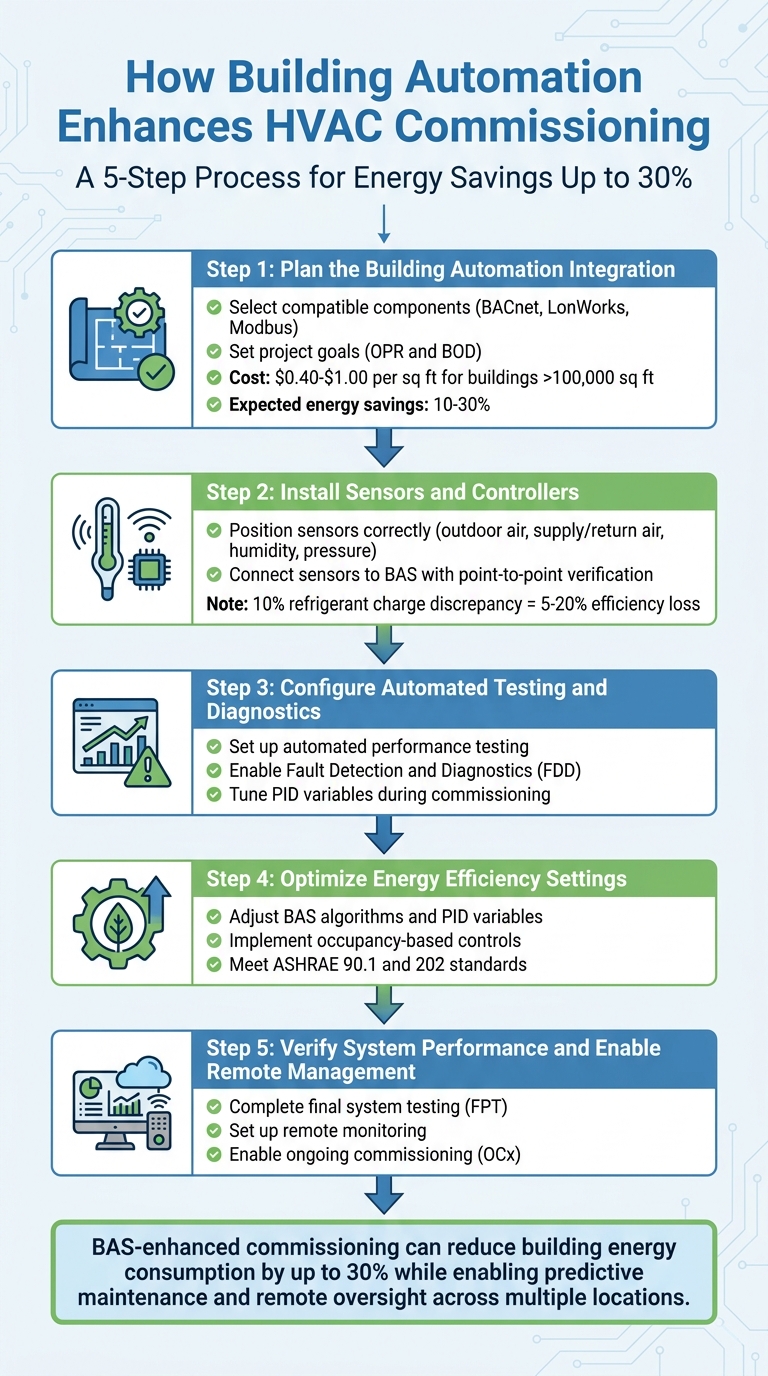
5-Step BAS-Enhanced HVAC Commissioning Process
Case Study: Implementing automated BAS Cx in Schools and Campuses
sbb-itb-034f8e1
Step 1: Plan the Building Automation Integration
Getting started with BAS integration begins well before any equipment is installed. The planning phase is critical – it lays the technical groundwork that determines whether your HVAC system will work seamlessly with automation controls or end up as a disconnected mess. Proper planning avoids costly mistakes and ensures the system hits its energy efficiency goals. Once the plan is solid, the next step is installing sensors and controllers.
Select Compatible Components
The communication protocols you choose are key to ensuring your BAS and HVAC systems work together. Opt for open protocols like BACnet (ASHRAE Standard 135), LonWorks, or Modbus. These allow equipment from different manufacturers to communicate without needing proprietary gateways. However, don’t just assume "BACnet compliant" means full compatibility – some devices may not expose all control points. Always request the Protocol Implementation Conformance Statement (PICS) for each device. This document will confirm which data points – such as temperature readings, fan speeds, or valve positions – are available for automation.
Integration involves four main technical layers: field devices, controllers, the network, and the supervisory server. Each layer needs to be carefully specified. For example, ensure your network has enough bandwidth, use VLAN segmentation for cybersecurity, and plan emergency power routing to keep controls operational during outages.
Mike Eardley highlights the importance of making these decisions wisely:
"A BAS that requires an exceedingly high level of operator skill or time commitment from the facility staff reduces the functionality of the building system just as much as faulty equipment does" [1].
In simpler terms, the system should match your staff’s skill level. A complex interface that no one can navigate can be as problematic as faulty hardware. By focusing on these details, you’ll set the stage for a smooth installation and better HVAC performance.
Set Project Goals
Start by defining clear, measurable goals. Develop the Owner’s Project Requirements (OPR) and the Basis of Design (BOD) to outline specific performance criteria like temperature setpoints, occupancy schedules, and acceptable humidity levels. For large buildings (over 100,000 square feet), a fully integrated BAS typically costs between $0.40 and $1.00 per square foot. This upfront investment can lead to energy savings of 10% to 30% [4].
Work with your IT team early to define remote access roles – who gets read-only access versus full control – and establish security measures. Also, decide on data trending requirements: how much historical data to store, how often to log it, and which points to monitor. This data is crucial for energy analysis and verifying seasonal performance after the system is up and running.
With ASHRAE Standard 90.1-2022 now mandating direct digital control for HVAC systems in zones larger than 5,000 square feet, thorough planning ensures compliance while unlocking the system’s full potential [4]. These steps are essential for achieving efficient and reliable HVAC performance.
Step 2: Install Sensors and Controllers
Once the planning phase is complete, the next step is to install sensors and controllers that gather real-time HVAC data. These devices measure key parameters like temperature, humidity, and pressure, feeding this data into the Building Automation System (BAS). This information allows the BAS to make informed, logic-based decisions. Without accurate sensor readings, even the most advanced automation system won’t achieve the energy savings or comfort levels you’re targeting.
Position Sensors Correctly
Getting sensor placement right is critical. Poor placement can result in inaccurate readings, which disrupt BAS operations. Mike Eardley from Cannon Design emphasizes this point:
"A sensor takes a measurement at a specific point that is intended to be representative of a larger condition. If this sensor is providing a measurement that is not true, the HVAC system will perform inefficiently and inconsistently with the design intent." [1]
To avoid false readings, outdoor air sensors should be positioned away from exhaust outlets or locations exposed to direct sunlight at various times of the day. For differential pressure sensors in ductwork or piping, follow the two-thirds rule: place them roughly two-thirds of the way down the system. This ensures the data reflects the overall network conditions [1].
Temperature sensors should monitor supply air, return air, and outdoor air to confirm that indoor conditions align with the Owner’s Project Requirements. Humidity sensors play a vital role in maintaining indoor air quality, particularly during seasonal changes. Pressure sensors ensure flow capacities are met at each load and support energy-saving measures like static pressure resets [1][6]. Even small deviations, such as a 10% refrigerant charge discrepancy, can reduce system efficiency by 5% to 20%. This can be identified through temperature and pressure sensor checks during commissioning [5]. Once sensors are validated, they should be promptly integrated into the BAS.
Connect Sensors to the BAS
After placing the sensors, the next step is to integrate them with the BAS. This involves point-to-point verification, where technicians ensure the physical measurements (like volts, amps, or pressure) from the sensors match the digital values displayed on the BAS interface [1].
Maintaining wiring integrity is also crucial. Keep control wiring separate from power lines and verify that the wires are of the correct gauge and length. Additionally, connect sensors and controllers to emergency power circuits to ensure the HVAC system operates correctly during power outages [1]. This step is essential for consistent and accurate system monitoring.
Set appropriate Change-of-Value (COV) rates to prevent overloading the network. For instance, if the COV is set too low – updating every time airflow changes by 0.1 CFM – the network can become overwhelmed, slowing down system responsiveness. Optimizing these settings ensures efficient data exchange and minimizes energy waste. Jeremy Bartlett from RMF Engineering explains:
"The lower the COV [Change-of-Value] setting, the higher the rate of data exchange across the building automation network; thus, the slower the network responds." [6]
Proper integration of sensors allows for real-time fault detection and can cut building energy consumption by as much as 30%, ensuring maximum efficiency from the very start of the commissioning process [3][7].
Step 3: Configure Automated Testing and Diagnostics
After installing sensors and integrating the BAS (Building Automation System), the next step is to ensure the system operates as intended. This involves configuring automated testing and fault diagnostics to verify HVAC performance. The Commissioning Authority (CxA) plays a key role here by developing Functional Performance Test (FPT) plans based on the Owner’s Project Requirements, Basis of Design, and approved submittals. These final FPTs are executed using BAS graphics to confirm proper operation sequences, alarms, safeties, schedules, and setpoints [1].
Set Up Automated Performance Testing
To assess actual HVAC performance and spot potential issues like cycling or overshooting, enable historical trend data within the BAS. Mike Eardley from CannonDesign underscores the importance of this step:
"Plotting this data against time will demonstrate whether there is hunting, cycling, overshooting, and other undesirable elements of system inefficiency and instability." [1]
During this phase, tuning PID (Proportional-Integral-Derivative) variables in the BAS is crucial. Proper tuning ensures the system responds quickly to setpoint changes without causing instability. Importantly, this tuning should be done during the commissioning process, not after occupancy, to avoid starting operations inefficiently. Additionally, before running final automated tests, confirm that air and water system balancing has been fully completed. Imbalanced systems can distort test results and lead to incorrect conclusions [1]. Once the control loops are fine-tuned, integrate fault detection for continuous monitoring.
Enable Fault Detection and Predictive Maintenance
Optimized control systems pave the way for Fault Detection and Diagnostics (FDD), which uses real-time data to uncover operational problems. By applying rules-based logic, the BAS can flag issues like simultaneous heating and cooling or incorrect economizer sequences when specific conditions arise [8]. Michael Eardley, Vice President at CannonDesign, explains the importance of FDD:
"A system fault that wastes energy may be chronically present, but may not be detected because there is no indication of a problem… The solution to identifying these sometimes hidden problems is automated fault detection and diagnostics (FDD)." [8]
To implement FDD effectively, map critical BAS variables – such as temperature setpoints, actual temperatures, outdoor air conditions, and schedules – into diagnostic rules. Configure the system to measure the impact of faults by tracking their duration and translating them into energy waste or financial losses [8]. This setup ensures the system remains efficient throughout its lifecycle, catching inefficiencies that manual inspections might overlook and helping to reduce operational costs over time.
Step 4: Optimize Energy Efficiency Settings
Once system performance has been verified, the next step is to fine-tune the BAS (Building Automation System) algorithms. The goal here is to maximize energy savings while ensuring occupant comfort. Use the temperature setpoints outlined in the Owner’s Project Requirements (OPR) as a guide for these adjustments [1]. This step builds directly on the performance data gathered in earlier commissioning stages.
Adjust BAS Algorithms
With verified sensor data and system diagnostics in hand, you can now adjust control parameters to improve energy efficiency. A good place to start is by fine-tuning the PID (Proportional, Integral, Derivative) variables. Proper tuning ensures the system reaches setpoints quickly and efficiently, avoiding unnecessary cycling. Mike Eardley, Associate Vice President at Cannon Design, describes the process:
"The tuning process changes the proportional, integral, derivative (PID) variables of the control loop to achieve the most effective system response." [1]
Beyond PID adjustments, consider implementing occupancy-based controls and smart scheduling. These strategies reduce energy waste by scaling back heating or cooling when spaces are unoccupied. Additionally, Demand Control Ventilation (DCV) can optimize airflow by responding to real-time occupancy levels in dynamic areas [3]. However, conflicts in control logic can sometimes disrupt these energy-saving measures. Howard Williams, Associate Editor at Electricity Forum, highlights this challenge:
"A control sequence may appear sound until simultaneous demands occur. Morning warm-up overlaps with demand limiting. Occupancy schedules collide with manual overrides." [2]
To avoid these issues, test how the system handles transitions between different operating modes. For example, evaluate how morning warm-up routines interact with occupancy schedules. This kind of testing ensures energy-saving sequences remain effective and conflict-free [2].
Meet Energy Code Requirements
Once the control loops are optimized, the next step is to ensure the system complies with energy codes. BAS integration plays a key role in meeting modern efficiency standards, such as ASHRAE 90.1 and ASHRAE Standard 202. These standards outline minimum energy performance requirements and commissioning processes [1]. Configuring BAS settings to adjust temperature and ventilation based on occupancy periods not only ensures compliance but also leads to measurable reductions in utility costs. This is particularly valuable for public institutions like schools, hospitals, and municipal buildings.
Verification is essential to this process. Make sure all sensors are properly calibrated with their controllers to provide accurate data. Additionally, analyze historical trend data by plotting it over time. This can help identify issues like cycling or instability in control loops, especially during seasonal changes [1].
Step 5: Verify System Performance and Enable Remote Management
This final phase ensures the HVAC system and building automation system (BAS) are fully operational and ready for long-term use. It also sets the stage for ongoing monitoring, allowing facility managers to maintain optimal performance over time.
Complete Final System Testing
Start by conducting point-to-point verification to confirm that field signals align with BAS-read values. Next, perform Functional Performance Testing (FPT) through the BAS interface. This step checks that sequences of operation, alarms, safety interlocks, and occupancy schedules function as intended. It also evaluates how the system handles operational loads. Seasonal testing during the first full heating and cooling cycles ensures the BAS can manage extreme environmental conditions. Additionally, test complete power disconnection to verify that BAS and HVAC controllers restart correctly using emergency power.
Trend data analysis is crucial for spotting performance issues early. The BAS logs historical data – like temperature and flow – allowing technicians to identify problems such as instability (e.g., cycling or overshooting). Setting up trending tools before functional testing begins helps resolve anomalies before the final walkthrough.
Once system performance is validated, shift focus to setting up remote monitoring for ongoing management.
Set Up Remote Monitoring
Remote access to the BAS allows facility managers to monitor operations and analyze trend data from off-site locations. This capability supports ongoing commissioning (OCx), which integrates automated functional testing to maintain efficiency over time. In fact, a BAS can cut energy use by as much as 30% [3].
Modern BAS systems use adaptive control logic to make real-time adjustments based on factors like occupancy, outdoor weather, and indoor air quality, instead of sticking to static schedules. Automated alerts notify facility managers of inefficiencies or deviations from the system’s design parameters, enabling proactive maintenance. Mike Eardley, Associate Vice President and Director of Commissioning Services at Cannon Design, highlights the importance of user-friendly systems:
"A BAS that requires an exceedingly high level of operator skill or time commitment from the facility staff reduces the functionality of the building system just as much as faulty equipment does." [1]
To ensure secure remote access, coordinate with IT professionals early in the process. Establish robust security protocols and confirm there’s enough network bandwidth during the design phase. Comprehensive training for facility staff on using the BAS remote interface – including data interpretation and scheduling maintenance – empowers them to maximize the system’s efficiency and maintain seamless operations.
Benefits of BAS-Enhanced HVAC Commissioning
Using a building automation system (BAS) during HVAC commissioning brings multiple advantages, including improved energy efficiency, lower maintenance costs, and better occupant comfort. Unlike traditional manual commissioning – which depends on static schedules and one-time checks – BAS-enhanced commissioning leverages real-time data from tools like occupancy sensors, outdoor temperature monitors, and air quality detectors. This enables continuous adjustments, ensuring energy is used only where and when it’s needed, potentially reducing overall consumption by up to 30% [3]. This dynamic approach stands in sharp contrast to the more rigid methods of manual commissioning.
BAS integration also helps establish a performance baseline while using historical data to quickly identify irregularities [1]. The Department of Energy reports that over 70% of residential air conditioner-heat pump systems have at least one fault that impacts performance – issues that could have been avoided with proper commissioning [9]. These faults result in an estimated $2.5 billion in wasted energy costs annually [9].
Advanced control tuning further enhances system efficiency by eliminating problems like hunting (constant cycling of equipment) and overshooting. Demand-controlled ventilation, another BAS feature, adjusts airflow based on real-time occupancy rather than fixed schedules. This approach significantly reduces both fan and thermal energy use in spaces with changing activity levels.
Howard Williams, Associate Editor at Electricity Forum, highlights the true purpose of commissioning:
"Commissioning is frequently misunderstood as inspection. In reality, it is alignment. It aligns design intent with actual behavior, control logic with physical response, and automation expectations with human operation" [2].
Adhering to structured commissioning guidelines can cut energy use in an average commercial building by as much as 20% [9]. These improvements not only enhance the initial commissioning process but also lay the groundwork for long-term energy efficiency and system dependability.
Comparison: Manual vs. BAS‑Enhanced Commissioning
The table below illustrates the key differences between manual and BAS-enhanced commissioning:
| Feature | Manual Commissioning | BAS‑Enhanced Commissioning |
|---|---|---|
| Energy Savings | Limited to static checks prone to drift [2]. | Up to 30% reduction through real-time optimization [3]. |
| Maintenance Needs | Reactive; issues found after equipment failure [2]. | Predictive maintenance using fault detection and trend analysis [1]. |
| Occupant Comfort | Inconsistent; relies on static schedules and manual overrides [2]. | High stability; adaptive controls adjust to real-time conditions [3]. |
| Cost Impact | Lower upfront cost but higher long-term expenses; contributes to $2.5B in annual wasted energy [9]. | Higher initial investment balanced by long-term savings [3]. |
| System Logic | Based on assumptions and theoretical schedules [2]. | Tested against real loads, behavior, and environmental conditions [2]. |
Conclusion
Building automation shifts HVAC commissioning from static checklists to a more dynamic focus on performance. This method bridges the gap between design intent and actual building behavior, ensuring control systems respond to real-world conditions rather than theoretical models [2]. The result? Facilities not only save energy but also establish a performance baseline that helps operators differentiate between normal fluctuations and genuine system issues.
The advantages go far beyond initial energy reductions. For public organizations – such as school districts, healthcare systems, universities, and municipalities – remote monitoring allows facility teams to oversee multiple buildings through centralized controls and access to trend data [1]. Additionally, post-occupancy commissioning during the early operational phases uncovers problems while equipment is still under warranty, saving on repair costs [1].
Mike Eardley, Associate Vice President and Director of Commissioning Services at Cannon Design, highlights the importance of timing:
"To maximize the benefits of the commissioning process and have the highest positive impact on a building throughout its lifecycle, commissioning must be performed early on as well as throughout construction and design – even during the planning phases of a building project" [1].
Starting early ensures that the complexity of the Building Automation System (BAS) matches the skill level of the facility staff.
The difference between basic checklist-driven commissioning and deeper BAS-integrated commissioning is striking. BAS-enhanced commissioning uses automated trending, fault detection, and predictive maintenance to prevent performance issues and address potential failures before they occur [2].
FAQs
What BAS data points matter most during HVAC commissioning?
When it comes to HVAC commissioning, key Building Automation System (BAS) data points play a crucial role. These include air and water flow rates, temperature setpoints, equipment status, and control sequences. Monitoring these parameters helps confirm that the system meets the owner’s requirements and aligns with the original design intent. This ensures the HVAC system operates correctly while maintaining energy efficiency.
How do you avoid sensor placement and calibration mistakes?
To ensure your building automation system operates reliably, it’s crucial to avoid mistakes during sensor installation and setup. Start by placing sensors in spots that truly represent the conditions you’re measuring. For example, steer clear of areas with airflow disruptions, direct sunlight, or nearby heat sources – they can skew readings.
Once installed, make sensor calibration a regular habit. Compare sensor readings to known standards and adjust them as necessary. This ongoing effort helps maintain accuracy and keeps your system performing as expected over time. Proper placement and consistent calibration go a long way in avoiding performance hiccups.
What does ongoing commissioning (OCx) look like with a BAS?
Ongoing commissioning (OCx) is all about keeping HVAC systems running at their best, and a Building Automation System (BAS) plays a key role in making that happen. Unlike the one-time process of initial commissioning, OCx is a continuous effort. It uses the BAS to monitor system performance, spot inefficiencies, and address problems like sensor inaccuracies or equipment malfunctions as they arise.
By automating alerts and fine-tuning operations, OCx helps maintain energy efficiency, reduce waste, and ensure that occupants remain comfortable over time. This proactive approach ensures your building stays efficient and responsive without requiring constant manual intervention.