

- test :
Continuous commissioning is helping Texas schools cut energy costs, improve comfort, and address aging infrastructure challenges. By using advanced systems like Building Automation Systems (BAS) and precise HVAC controls, schools can proactively manage energy use and reduce expenses. Examples include Bryan ISD saving $763,908 annually and Donna ISD projecting $10.7 million in savings over 15 years. These upgrades not only lower utility bills but also improve air quality and classroom conditions, all without disrupting school operations. Partnering with experts like E3 ensures tailored solutions and efficient implementation, making this approach ideal for budget-conscious districts.
Key takeaways:
- Energy savings: Schools save 15%-20% on energy costs.
- Improved air quality: Systems provide better ventilation and temperature control.
- Cost-effective upgrades: Funded through energy savings, minimizing upfront costs.
- Real results: Bryan ISD and Donna ISD show measurable financial and operational improvements.
This approach offers a practical way for schools to modernize facilities while staying within budget constraints.
Dr. David Claridge on Continuous Commissioning
sbb-itb-034f8e1
Case Study: Texas School District Implementation
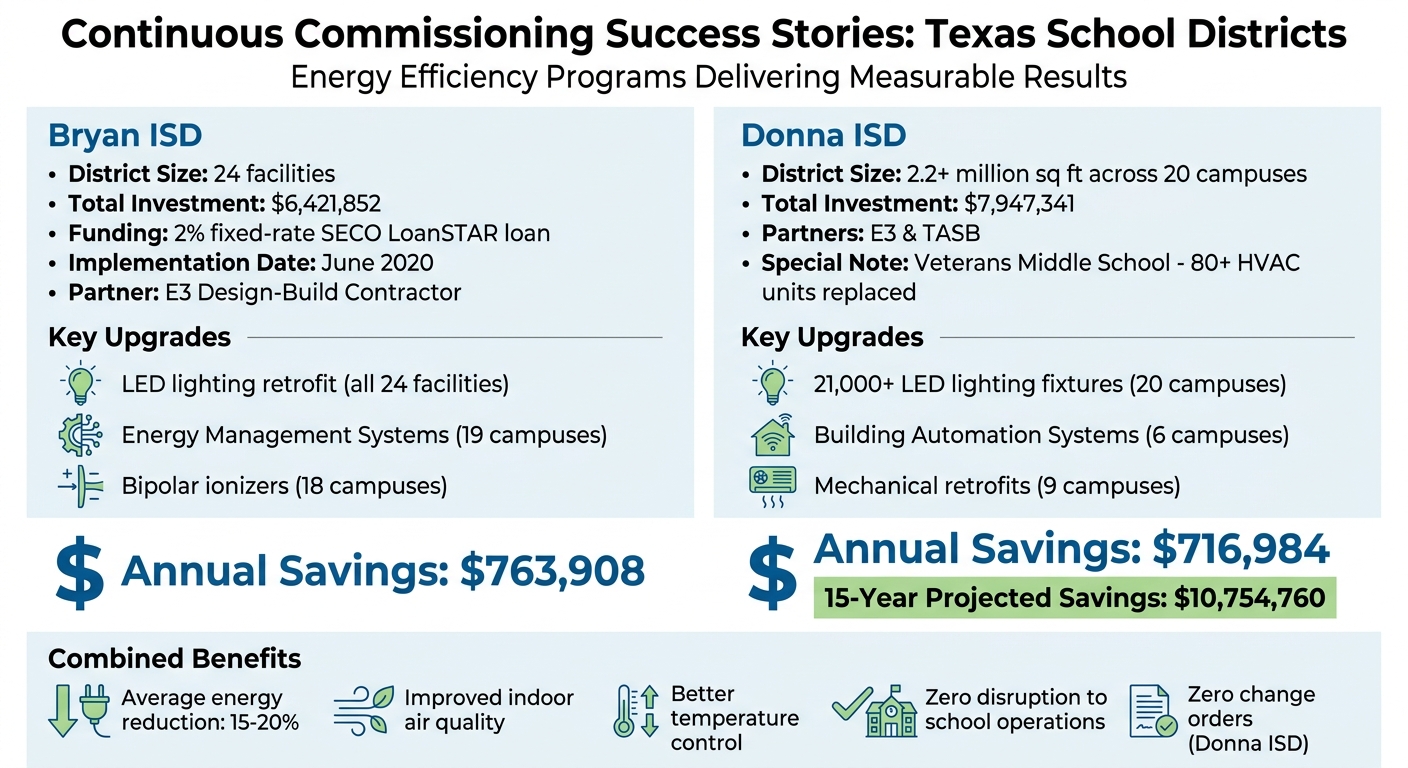
Texas School Districts Energy Savings Through Continuous Commissioning
Problems Before Implementation
Bryan ISD faced serious challenges across its 24 facilities. The district relied on outdated lighting systems that wasted energy, lacked centralized HVAC control via Energy Management Systems, and operated aging mechanical systems that were far from efficient. Indoor air quality was another major concern, as modern ventilation controls and air purification systems were missing. To make matters worse, high utility costs placed a heavy burden on the district’s budget[3].
Donna ISD, which oversees more than 2.2 million square feet of facilities, dealt with similar issues. At Veterans Middle School alone, over 80 HVAC units were failing and needed replacement due to mechanical breakdowns[1]. These mounting problems created an urgent need for targeted upgrades through continuous commissioning.
Implementation Process
In June 2020, Bryan ISD teamed up with E3 Design-Build Contractor to launch a $6,421,852 energy efficiency initiative funded by a 2% fixed-rate SECO LoanSTAR loan[3]. The project included a district-wide LED lighting retrofit for all 24 facilities, centralized HVAC control through optimized Energy Management Systems at 19 campuses, and the installation of bipolar ionizers at 18 campuses to enhance indoor air quality.
Donna ISD adopted a similar strategy with its $7,947,341 program in collaboration with E3 and TASB. This initiative involved retrofitting more than 21,000 LED lighting fixtures across 20 campuses, installing Building Automation Systems at six campuses to enable precise climate control, and completing mechanical retrofits at nine campuses. These upgrades not only resolved immediate equipment failures but also laid the groundwork for improved long-term operational efficiency[1].
Results and Measured Outcomes
The results were impressive. Bryan ISD now saves $763,908 annually[3]. Donna ISD achieved $716,984 in yearly savings, with total projected savings of $10,754,760 over 15 years[1]. Beyond the financial benefits, these upgrades provided students and staff with more stable indoor temperatures, better air quality, and improved lighting across their facilities. This case study highlights how continuous commissioning can drive lasting energy efficiency and operational improvements for school districts.
Benefits of Continuous Commissioning for Schools
Energy Savings and Lower Costs
Continuous commissioning helps school districts save substantial amounts of money, which is a big deal for schools working with tight budgets. Some districts have saved hundreds of thousands of dollars each year, freeing up funds that can be redirected into classrooms. Instead of wasting money on outdated HVAC systems or inefficient lighting, schools can focus on hiring teachers, upgrading technology, or enhancing educational programs. On average, energy use drops by 15% to 20%[2], offering not just immediate savings but also long-term budget predictability. These savings also contribute to creating healthier and more comfortable school environments.
Better Indoor Air Quality and Comfort
When building systems are optimized, both students and staff feel the difference. Properly tuned systems ensure consistent temperature control, balanced humidity, and improved air quality – all of which are essential for a productive learning atmosphere. A well-regulated environment helps everyone focus better, making it easier for students to learn and for teachers to teach.
Long-Term Building Performance
Continuous commissioning isn’t just about short-term gains – it’s about ensuring that school buildings perform well for years to come. Systems like Building Automation Systems and Energy Management Systems provide ongoing monitoring and adjustments[1][3], catching issues early before they turn into costly repairs.
Another advantage? These upgrades are implemented without interrupting daily school operations[1][3]. Over time, this approach protects the district’s investment, ensuring that buildings continue to save energy and provide comfort for decades. It’s a smart way to maintain efficiency and avoid future headaches.
E3 Design-Build Contractor‘s Role in Continuous Commissioning

Custom Solutions for Texas Schools
E3 Design-Build Contractor collaborates closely with Texas school districts to create energy-efficiency programs tailored to the unique needs of each campus. Instead of using a generic approach, E3 evaluates each facility individually and develops solutions to address its specific challenges. For instance, in a significant project for a Texas school district, E3 implemented upgrades like LED lighting retrofits, Building Automation Systems, and mechanical updates. A key highlight of this initiative was replacing over 80 HVAC units at Veterans Middle School[1]. This personalized approach forms the foundation of E3’s strategy for continuous commissioning in educational facilities.
Focus on Energy Efficiency and Comfort
With a team that includes Professional Engineers (PE), Certified Energy Managers (CEM), and LEED AP professionals, E3 prioritizes creating comfortable learning spaces while enhancing energy efficiency. At Sour Lake Elementary in Hardin-Jefferson ISD, E3 addressed temperature control issues by installing advanced HVAC systems equipped with fresh-air rooftop units and upgraded ductwork, allowing for individual classroom temperature control. The project also featured campus-wide LED lighting and an integrated building automation system. These efforts not only improved comfort and efficiency but also earned the project recognition as the TEMA Project of the Year. Additionally, the district benefited from utility rebates and long-term energy savings[4]. These targeted improvements highlight the broader impact of continuous commissioning on both comfort and operational effectiveness.
Proven Results with Continuous Commissioning
E3’s approach consistently delivers measurable outcomes, offering long-term energy and cost savings that often fund themselves. By combining technical expertise with strategic financial planning, E3 develops programs that provide immediate financial benefits while ensuring sustainable performance improvements over time[4].
Conclusion
Summary of Benefits
Continuous commissioning offers measurable energy savings, improved comfort, and long-term reliability. The examples from Texas school districts highlight its tangible impact. For instance, Donna ISD’s $7.9 million energy conservation initiative is expected to save $716,984 annually, while Bryan ISD achieved annual savings of $763,908 [1][3]. These projects demonstrate how continuous commissioning leads to self-sustaining improvements that positively impact students, staff, and budgets. The results emphasize the importance of having experienced partners to ensure successful implementation.
Why Choose E3 for Continuous Commissioning
E3 provides a comprehensive, turnkey solution for continuous commissioning tailored to Texas school districts. Their expertise ensures that major upgrades, such as retrofits, can be completed during the school year without disrupting classroom activities. E3’s design-build approach handles everything – from initial utility assessments to final implementation – and secures low-interest funding through programs like SECO LoanSTAR. Their dedication to budget management is clear in projects like Donna ISD, which was completed with zero change orders despite its extensive scope [1]. With a team of Professional Engineers, Certified Energy Managers, and LEED AP professionals, E3 integrates Building Automation Systems, HVAC upgrades, LED lighting, and indoor air quality enhancements into seamless programs designed specifically for Texas schools.
FAQs
How is continuous commissioning different from a one-time energy audit?
Continuous commissioning focuses on the ongoing monitoring and fine-tuning of a building’s systems to maintain peak energy efficiency, comfort, and overall performance. Unlike a one-time energy audit – which provides a temporary assessment of potential improvements – continuous commissioning ensures that systems operate as designed over time. This proactive approach identifies and resolves issues before they escalate, helping to prevent system inefficiencies, cut down on energy waste, and improve occupant comfort. A single audit, on the other hand, typically stops at offering recommendations, without the benefit of ongoing adjustments or oversight.
How quickly can a school district see payback from BAS, HVAC, and LED upgrades?
School districts often see a return on investment within 1 to 3 years after upgrading systems like BAS, HVAC, and LED lighting. Take Bryan ISD and Donna ISD, for instance – they’ve reported yearly savings between $716,984 and $763,908, depending on the scale of their upgrades and the resulting efficiency improvements.
What data does a Building Automation System need to maintain savings?
Building Automation Systems rely on precise energy consumption data, including electricity, heating, cooling, and hot water usage. They also require details like building operation set points and valve statuses to ensure energy-saving measures are effective. This information plays a crucial role in improving energy efficiency while keeping indoor conditions comfortable.