
- test :
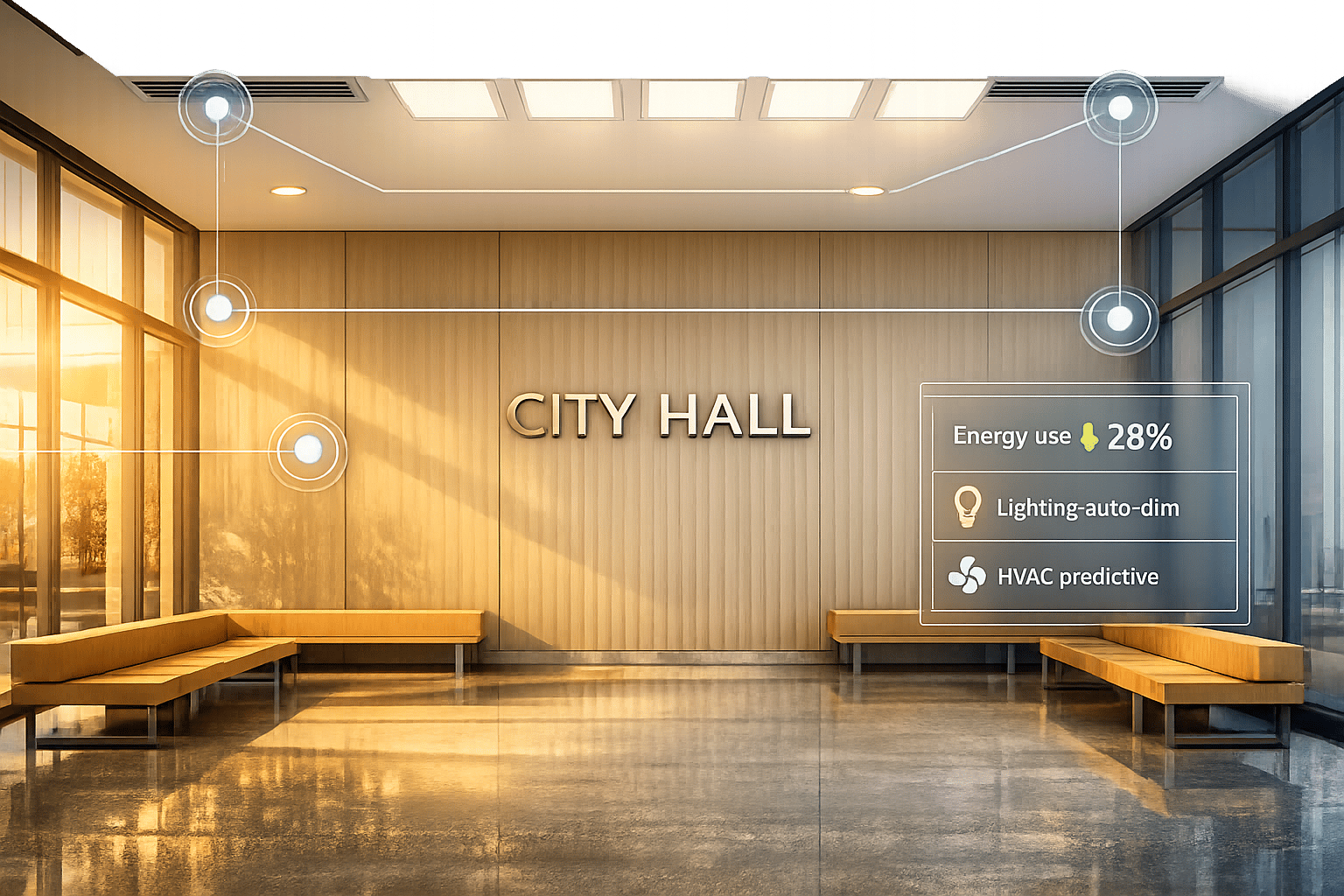
Municipal buildings often face high energy costs due to outdated systems and inefficient operations. IoT offers a solution by providing real-time data, enabling better energy management, reducing maintenance costs, and extending equipment life. Here’s how:
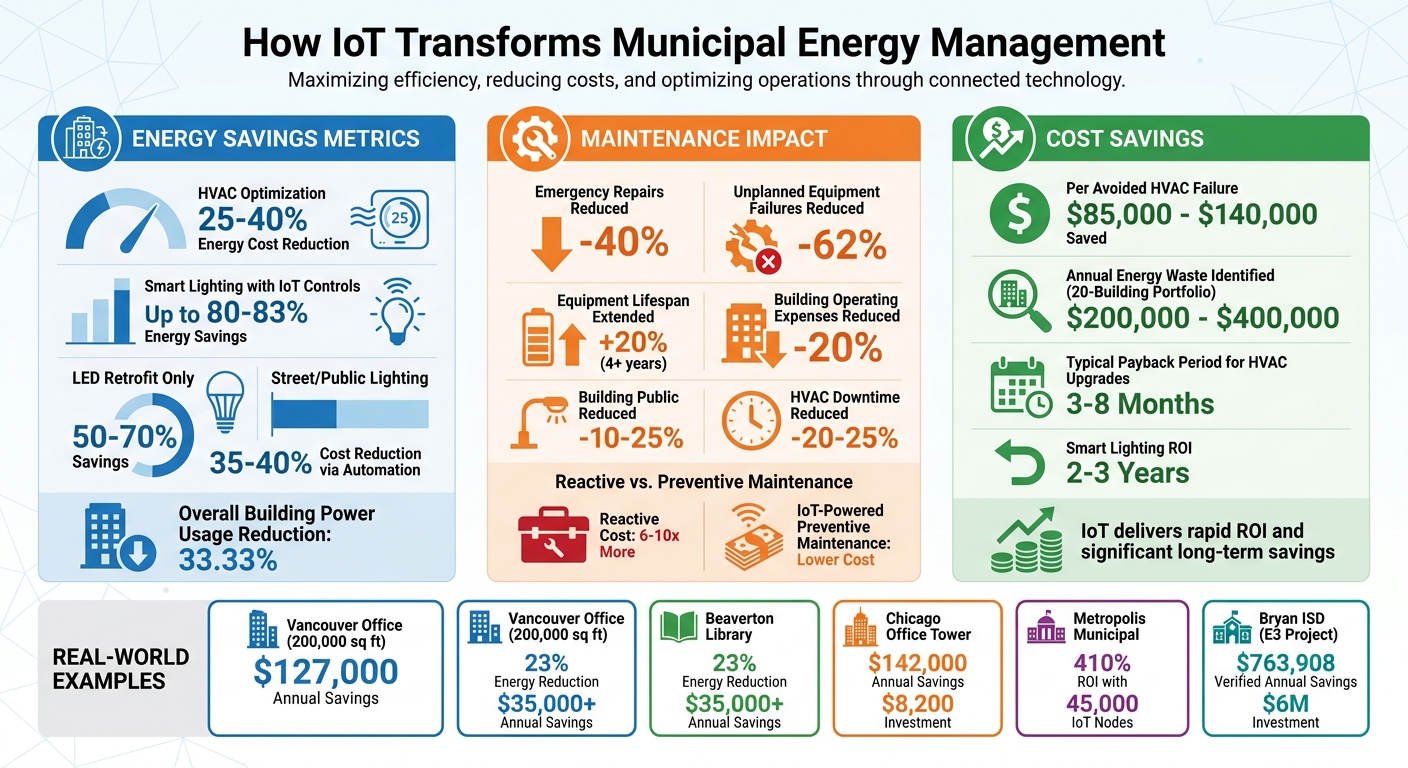
- Energy Savings: IoT sensors optimize HVAC and lighting, cutting energy costs by 25–40% in buildings and up to 80% with smart lighting controls.
- Predictive Maintenance: Early fault detection reduces emergency repairs by 40%, saving $85,000–$140,000 per avoided HVAC failure.
- Real-Time Monitoring: Dashboards track energy use and equipment performance, identifying inefficiencies like stuck dampers or leaking valves.
- Integration with Existing Systems: IoT connects to current Building Management Systems (BMS), improving performance without needing major replacements.
For example, Vancouver’s IoT upgrades in a 200,000-square-foot office saved $127,000 annually, while Beaverton, Oregon reduced energy use by 23% at its library. IoT isn’t just about saving money – it’s about smarter, data-driven facility management.
IoT Energy Savings in Municipal Buildings: Key Statistics and ROI
Real-Time Energy Monitoring with IoT
IoT Sensors for Data Collection
Municipal facilities rely on sensors to keep tabs on energy usage. For instance, current transducers (CTs) are attached to AHU fans, chiller compressors, and pump motors to measure runtime, power draw, and cycling patterns – all without interfering with the existing equipment setup [1][11]. Electrical submeters are another tool, installed either at the building or circuit level to record kWh consumption. Some advanced meters even provide second-by-second readings for highly detailed monitoring [6][11].
Occupancy sensors use technologies like passive infrared (PIR), thermal imaging, or cellphone hotspot detection to track presence, while environmental sensors measure factors such as temperature, humidity, CO₂ levels, and volatile organic compounds (VOCs) [6][10][11]. These sensors send their data using communication methods like LoRaWAN, Zigbee, cellular networks, or Wi-Fi. Gateways with edge processing help cut down bandwidth usage by as much as 70% [6][7]. This constant stream of high-resolution data powers real-time dashboards, enabling quick adjustments to improve energy efficiency.
Immediate Insights for Energy Optimization
The data collected by these sensors is fed into analytical tools, creating real-time dashboards that provide facility managers with updates at 15-minute intervals. This level of visibility makes it easier to identify unusual energy consumption patterns quickly [12]. For example, when sensors detect issues like stuck dampers, leaking valves, or lights left on for too long, the system can automatically generate work orders. This eliminates the need for manual inspections and speeds up maintenance.
A great example of this approach comes from Beaverton, Oregon. Starting in 2012, the city introduced real-time monitoring at its Main Branch Library and City Hall. By analyzing 15-minute interval data, staff identified problems like stuck dampers and unnecessary lighting. By July 2014, the library reduced its energy use by 23%, and City Hall cut its usage by 15%. Together, these efforts saved over $35,000 annually, while the three-year monitoring service cost just $17,000 [12].
Modern IoT platforms also work seamlessly with existing Building Automation Systems (BAS) and SCADA networks. They use standardized protocols like MQTT, REST APIs, OPC-UA, and BACnet to integrate smoothly. This layered approach allows for operational adjustments based on data insights. Studies show that 74% of energy savings in large-scale deployments come from these kinds of corrections, often without needing extra capital investment [11].
sbb-itb-034f8e1
HVAC Optimization with IoT
Demand-Driven System Adjustments
Municipal HVAC systems account for a hefty 40–60% of energy costs, making them ideal candidates for IoT-driven improvements[15][13]. While traditional building automation systems focus on monitoring whether equipment is running, IoT sensors dive deeper. They track actual outcomes – like whether the air is cooling properly, dampers are functioning as intended, and airflow is reaching designated zones[15][1].
Using occupancy data, IoT enables HVAC systems to operate based on real-time demand. Instead of sticking to rigid schedules, occupancy sensors allow spaces like courtrooms, libraries, and community centers to adjust heating and cooling automatically in unoccupied areas[6][10][14]. CO₂ sensors add another layer of efficiency by fine-tuning outside air intake based on actual occupancy. This approach, known as demand-controlled ventilation, can cut the energy needed to condition fresh air by 20% to 40%[15].
IoT also helps pinpoint inefficiencies, such as simultaneous heating and cooling caused by misaligned controls. For example, in a 380,000 sq. ft. Chicago office tower, IoT sensors uncovered this issue across 8 floors. By recalibrating 89 sensors and replacing 4 actuators – an $8,200 investment – the building saved $142,000 annually in energy costs and reduced comfort complaints by 67%[15].
These adjustments translate into tangible savings, as the following section highlights.
Energy Savings and Cost Reductions
IoT-powered HVAC systems can deliver impressive financial benefits, with municipal facilities seeing energy cost reductions of 25% to 40%[15]. Specific strategies target different areas for savings. For instance, optimizing temperature setpoints using outdoor weather data can save 8% to 12%, while occupancy-based scheduling can cut energy use by 15% to 25% in civic buildings[14].
| Facility Type | Potential Reduction | Key IoT Strategy |
|---|---|---|
| Courthouses | 22–35% | Zone-level control; schedule integration with court dockets |
| Libraries | 18–28% | Separate zones for computer labs vs. reading areas; CO₂-based ventilation |
| Community Centers | 25–40% | Event-driven scheduling; gym-specific air change rates |
| Admin Buildings | 20–32% | Aggressive night/weekend setbacks; pre-conditioning 1–2 hours before arrival |
Investments ranging from $8,000 to $15,000 per building can lead to annual savings of $25,000 to $60,000. With payback periods as short as 3–8 months for key HVAC upgrades, the financial case for IoT is compelling[14][15][11]. Beyond cutting energy costs, IoT systems also reduce HVAC downtime by 20% to 25% and extend equipment life by 15% to 20%[13].
Smart Lighting Controls Using IoT
Motion and Ambient Light Sensors
IoT lighting systems are transforming static schedules into dynamic, responsive solutions. With Passive Infrared (PIR) motion sensors, lights activate at full brightness only when they detect movement from people or vehicles, then dim during periods of inactivity[17][8]. Meanwhile, ambient light sensors (LDR) measure natural daylight levels to implement "daylight harvesting." This means artificial lighting is automatically reduced or turned off when sunlight provides sufficient illumination[8][19].
These sensors connect to cloud-based platforms, letting municipalities remotely adjust dimming profiles across entire neighborhoods or specific zones[17][8]. The system also tracks energy usage and operational performance, quickly identifying issues like "dayburners" – fixtures that waste energy by staying on unnecessarily. A single dayburner can cost $120 to $180 annually per fixture if not addressed[8].
Combining LED retrofits with IoT controllers that integrate both motion and ambient light sensors can amplify energy savings to as much as 80%. While LEDs alone save 50–70%, adding adaptive controls significantly boosts efficiency[8]. For example, a 2018 study in Italy showed that smart lighting systems with motion and presence sensors achieved 82.99% energy savings, nearly doubling the 42.07% savings from LEDs alone[19].
These adaptive systems not only improve energy efficiency but also set the stage for long-term savings and smarter energy management.
Energy Savings from Smart Lighting
Street and public lighting can consume up to 40% of a municipality’s electricity budget[8]. IoT-enabled lighting systems help slash this expense, cutting energy costs by 35–40% through intelligent automation[16]. Across both indoor and outdoor municipal settings, these systems reduce power usage by approximately 33.33%[18].
The cost of IoT controllers ranges from $50 to $150 per node for LED-equipped systems. For mid-sized municipalities managing 10,000–30,000 lights, implementation costs fall between $40,000 and $80,000[8]. Cities typically recover these costs within 2–3 years through combined energy and maintenance savings[8]. Additionally, smart dimming extends LED lifespan by minimizing thermal stress[8].
When paired with broader IoT strategies, smart lighting becomes a cornerstone of energy-efficient municipal retrofits.
| Lighting Approach | Energy Savings | Key Features |
|---|---|---|
| LED Retrofit Only | 50–70% | Efficient bulbs with fixed timers or photocells[8] |
| LED + IoT Controls | Up to 80–83% | Adaptive dimming, motion response, daylight harvesting[8][19] |
Cost-effective building management with IoT technology
Predictive Maintenance Powered by IoT
IoT technology goes beyond real-time monitoring to enable predictive maintenance, helping organizations anticipate equipment issues and cut down on repair costs.
Early Fault Detection with AI Diagnostics
IoT sensors keep a constant watch on municipal equipment by tracking key metrics like vibration, temperature, pressure, and amp draw. These measurements are converted into digital alerts for analysis by AI diagnostics[2]. The AI identifies patterns – such as unusual voltage spikes or pressure drops – that indicate potential problems before equipment actually fails[2][20].
Each asset’s baseline performance is established, and any deviations trigger alerts. For instance, if a chiller’s refrigerant pressure drops below normal or a pump shows excessive vibration, the platform notifies operators and provides an estimate of the remaining useful life. This allows maintenance to be scheduled during less disruptive times.
Take the example of a university campus with 45 buildings, which used a centralized HVAC maintenance platform from March 2024 to September 2025. Faced with a $38 million backlog in deferred maintenance, the institution integrated IoT sensors into critical systems like central chiller plants. The result? Unplanned equipment failures dropped by 62%, and the average equipment lifespan increased by over four years. In one case, vibration sensors detected bearing wear six weeks before a major failure, saving approximately $92,000 in emergency repair costs[22].
"If a pump vibrates abnormally, a work order is generated automatically. We’ve moved from chaos to control." – Director of Public Works, City of Innovation[2]
Sensor trend analysis typically provides about 30 days of advance notice before HVAC or pump station failures occur[1]. These early warnings not only improve reliability but also pave the way for significant financial savings.
Cost Savings with Proactive Maintenance
Predictive maintenance has a major financial upside. Municipalities using IoT-connected systems report a 40% drop in unplanned equipment failures[1]. Reactive repairs can cost 6 to 10 times more than preventive maintenance supported by IoT[3]. Avoiding just one unplanned HVAC failure can save between $85,000 and $140,000 per event[1].
Predictive programs also extend equipment life by about 20% – adding over four years to systems with a 20-year baseline lifespan[22]. Small issues like clogged filters or worn belts are caught early, preventing more severe damage to motors and compressors. Overall, IoT technology can reduce building operating expenses by 20%[21].
| Asset Type | Sensor Technology | Predictive Capability | Potential Savings |
|---|---|---|---|
| Chillers/HVAC | Vibration, Refrigerant Pressure, Amp Draw | Detects failure 2–3 weeks early[14] | $15,000–$35,000 per emergency repair[14] |
| Pump Stations | Vibration, Motor Current, Flow Rate | Identifies bearing degradation 30–90 days out[1] | $45,000–$180,000 per avoided failure[1] |
| Electrical Panels | Thermal Imaging, Load Monitoring | Detects insulation issues weeks before failure[1] | Prevents fires and costly switchgear replacements[22] |
IoT systems integrate seamlessly with Computerized Maintenance Management Systems (CMMS), automatically generating work orders complete with asset history and parts lists[2]. This setup eliminates delays between detection and action, ensuring crews arrive equipped with the necessary tools and materials. Municipalities report a 35% to 50% reduction in unplanned service disruptions with these systems[3].
Integrating IoT with Municipal Building Automation
Automated Efficiency with IoT and BMS
Many aging municipal buildings already have HVAC controllers, utility meters, and building management system (BMS) hardware in place. However, the issue lies in what experts call the "connectivity gap." These systems generate data, but it often goes uncaptured, unanalyzed, and unused [1].
By retrofitting IoT into existing building automation systems, this gap can be closed. Adding sensors, actuators, and controllers allows data to flow directly into the BMS. Open protocols like BACnet and MQTT enable older hardware to communicate effectively with modern IoT platforms [23]. This shift transforms outdated, static schedules into dynamic systems that adjust in real time. For example, instead of relying on fixed HVAC and lighting schedules, adaptive controls can respond to actual occupancy, ensuring energy is only used when needed [1][8].
"The gap is not hardware – it is connectivity. HVAC controllers, utility meters, and BMS systems are generating the data. No platform is capturing, analyzing, or acting on it." – Sam, Oxmaint [1]
IoT integration also streamlines maintenance. If sensors detect anomalies like a voltage drop or pressure change, automated workflows can trigger work orders directly in the maintenance management system. This eliminates delays caused by manual reporting and reactive maintenance [4]. Additionally, smart building analytics can reveal significant savings – between $200,000 and $400,000 annually in energy waste across a 20-building municipal portfolio. Optimizing energy setbacks through IoT can further cut HVAC energy use by 20% to 25% [1].
With these integration benefits, specialized contractors are taking sustainable retrofits to the next level.
E3 Design-Build Contractor‘s Building Automation Solutions

E3 Design-Build Contractor has embraced IoT advancements to provide municipalities with cost-effective retrofit solutions. Their expertise focuses on integrating IoT-enhanced HVAC systems, allowing facilities to transition from rigid schedules to occupancy-based automation. By pairing LED lighting upgrades with smart sensors and linking these improvements to centralized BMS platforms, E3 helps municipalities bridge the gap between data and actionable insights – without the need for costly full-system replacements.
E3’s design-build model ensures IoT integration works seamlessly with each facility’s existing infrastructure. At the same time, their approach meets government security standards while delivering measurable energy savings and cost reductions, as highlighted earlier.
Steps to Implement IoT in Municipal Retrofits
Assessment and Planning
Start by taking stock of all existing assets – things like HVAC controllers, utility meters, and building management systems (BMS). Document details such as their type, age, condition, location, and importance to daily operations. This inventory will give you a clear picture of what you’re working with and help identify any gaps or outdated equipment [3][9]. At the same time, evaluate your network options – whether it’s LoRaWAN, cellular, or Wi-Fi – and set measurable goals, such as energy savings, equipment uptime, or cost reductions [3]. Aim to complete this groundwork within four weeks to ensure a strong start [3][9].
Once you’ve mapped out your assets and network capabilities, you’re ready to move on to deploying sensors and integrating systems.
Sensor Installation and Integration
Building on your assessment, the next step is to install and integrate sensors. This phase typically takes about eight weeks and begins with focusing on high-priority areas first [3][9]. Starting small allows you to fine-tune alerts and ensure the data you’re collecting is accurate.
To make the most of your IoT data, integrate it with systems like CMMS (Computerized Maintenance Management Systems), GIS (Geographic Information Systems), and BMS using cloud-based APIs [3][5]. Avoid creating data silos by adopting a unified gateway setup. This type of architecture can translate various manufacturer protocols (like MQTT or REST APIs) into standardized data streams [3][7]. Additionally, using edge gateways can process and filter data locally, cutting bandwidth usage by up to 70% and enabling real-time alerts [7][5].
After the sensors are up and running, continuous monitoring becomes key to achieving your energy and operational goals.
Monitoring and Performance Evaluation
Streamline your monitoring by consolidating all sensor data into a single dashboard. This makes troubleshooting faster and more efficient [7]. A unified dashboard equipped with AI-driven tools can also help track critical metrics like battery levels, signal strength, and packet loss, allowing you to schedule maintenance proactively [7].
Performance evaluation involves digging into detailed data to uncover inefficiencies. For instance, analyzing utility meter data at 15-minute intervals can highlight issues like HVAC systems running unnecessarily in unused areas over the weekend [1]. To maintain accuracy, establish regular calibration schedules – every 90 days for air quality sensors and monthly for water probes [24]. A structured 90-day optimization plan can guide your team through different stages: basic monitoring during the first 30 days, adding resilience measures like redundant data paths in the next 30 days, and finally, leveraging AI for anomaly detection and calculating ROI in the last 30 days [7].
Conclusion
The Internet of Things (IoT) is reshaping how municipalities manage aging facilities, turning reactive strategies into proactive, data-driven systems with measurable outcomes. Municipalities that implement IoT monitoring see 45% fewer emergency infrastructure failures, while reactive repairs can cost 6–10 times more than preventive measures powered by IoT insights [3]. For a typical 20-building municipal portfolio, smart analytics can uncover $200,000 to $400,000 in annual energy waste – money often lost to unoccupied buildings running systems or streetlights left on during daylight hours [1].
This transition to real-time monitoring doesn’t just reduce emergencies; it also extends asset lifespans by 25–28% and cuts maintenance costs by 30–40% through better scheduling [3][5]. A standout example is the Metropolis Municipal Government, which deployed 45,000 IoT nodes across its infrastructure in March 2026. Over two years, they achieved a 410% return on investment and reduced citizen complaints by 88% [4]. Sarah Jenkins, Chief Innovation Officer at Metropolis Municipal Government, summed it up perfectly:
"We saved a $120,000 asset with a $40 part. That is the definition of smart city maintenance" [4].
Integrated retrofit solutions have also proven game-changing. E3 Design-Build Contractor has brought this level of efficiency to Texas municipalities, offering design-build solutions that incorporate IoT-enabled building automation systems, high-efficiency HVAC controls, and smart LED lighting. Their approach ensures upgrades are completed without disrupting daily operations. For example, between June 2020 and 2021, E3 partnered with Bryan ISD to implement over $6 million in energy efficiency improvements across 24 facilities, yielding $763,908 in verified annual savings [25].
The true value of IoT lies in its ability to transform raw data into actionable insights, improving decision-making at all levels of municipal management [5]. Whether the goal is reducing emergency failures, extending equipment life, or achieving substantial energy savings, IoT integration provides the evidence needed to make smarter choices and secure federal grants for infrastructure updates [5]. This data-driven approach forms the foundation of smart municipal management and supports comprehensive retrofit solutions.
With its expertise in building automation, energy management, and infrastructure upgrades, E3 helps municipalities achieve these outcomes while creating sustainable, comfortable environments for their communities.
FAQs
Which IoT sensors should we install first in an older municipal building?
For aging municipal buildings, integrating IoT sensors can deliver quick, actionable insights into energy usage and occupancy patterns. Start with circuit-level energy meters to track energy consumption in real time, making it easier to pinpoint areas of inefficiency. Pair these with occupancy sensors to adjust HVAC and lighting systems based on actual usage, cutting down on unnecessary energy waste.
To further enhance efficiency, consider adding vibration and temperature sensors to HVAC systems. These sensors enable predictive maintenance, helping to avoid expensive breakdowns while boosting both energy efficiency and system reliability.
How does IoT connect to our existing BMS without replacing everything?
IoT devices, such as sensors and controllers, can seamlessly connect with your current Building Management System (BMS) through retrofitting. This method allows the system to gather real-time data on key metrics like temperature, energy consumption, and occupancy. By doing so, it boosts operational efficiency without requiring a complete system overhaul. These IoT components complement your existing setup, introducing smarter functionality and connectivity while preserving the original infrastructure.
What cybersecurity steps are needed for municipal IoT deployments?
To keep municipal IoT deployments safe, it’s crucial to focus on strong network security practices. This means using tools like encryption, firewalls, and secure access controls to protect your systems. Make sure to regularly update firmware and apply patches to fix any vulnerabilities that might arise.
You should also rely on monitoring tools and intrusion detection systems to quickly spot potential threats. Having an IoT-specific incident response plan in place ensures you’re ready to act if something goes wrong. Another smart move? Keep IoT networks separate from critical IT systems – this limits the damage if a breach occurs.
A multi-layered security strategy is key to safeguarding both your infrastructure and data.