
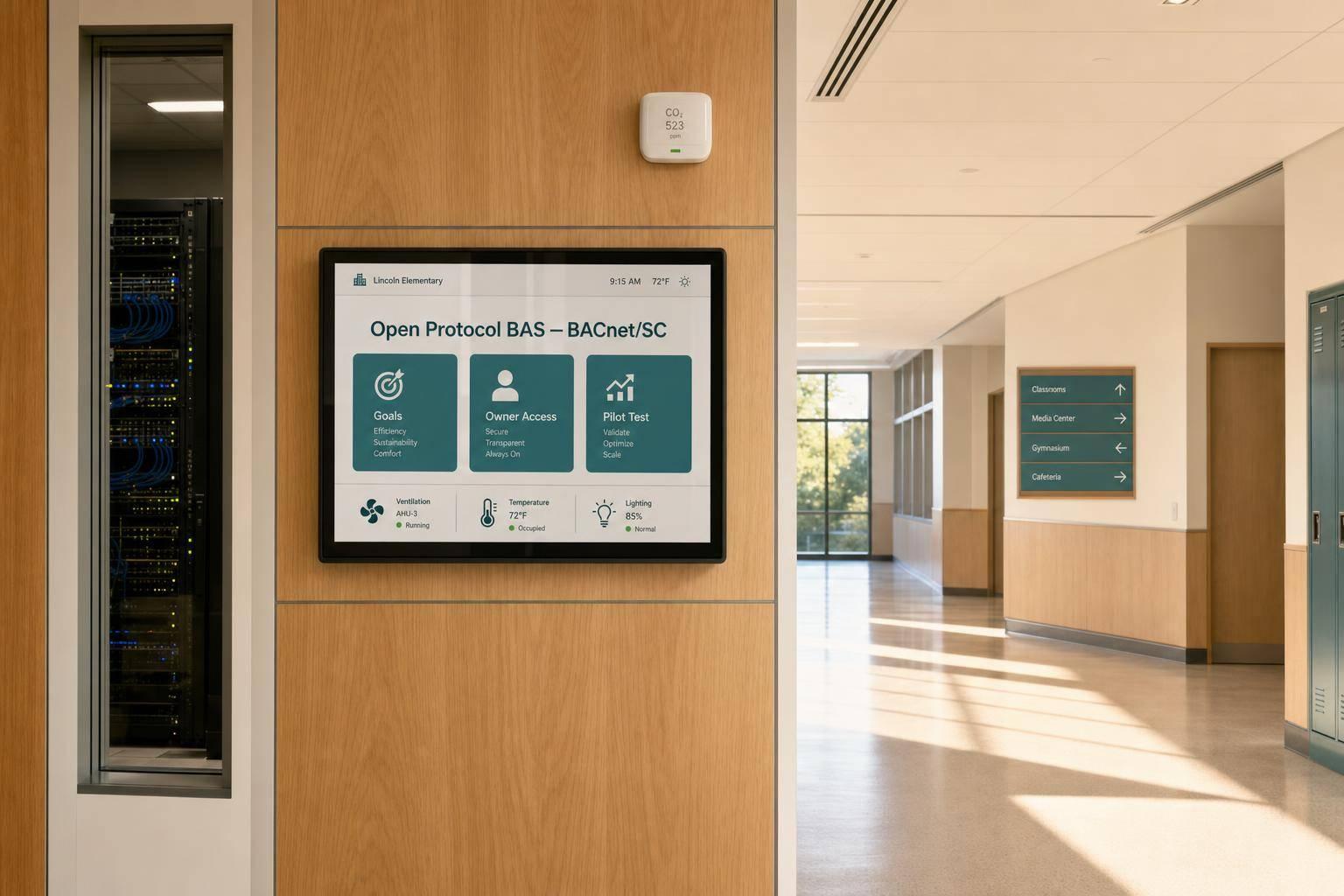
- test :
If I were buying a BAS for a school district, I’d start with one rule: require native open protocols and full owner access from day one. That single choice affects service options, future upgrades, IT setup, training, and long-term cost.
Here’s the short version. This guide explains how I’d buy an open protocol BAS for schools by first setting district goals, then listing every system to control, checking old equipment, comparing BACnet, Modbus, and LonWorks, lining up with IT, and writing an RFP that blocks vendor lock-in. It also covers pilot rollout, closeout documents, training, and seasonal testing.
A few facts stand out:
- BACnet holds more than 60% of the global BAS protocol market.
- More than 1,300 products have BTL certification.
- ASHRAE Guideline 36 can support 5% to 15% energy savings when sequences are set up the right way.
- Districts should ask IT for VLANs, IPs, and firewall rules at least 60 days before commissioning.
- A pilot campus should include 20% spare I/O and 10% spare switch ports for future growth.
What I’d check before award:
- District goals for comfort, IAQ, energy, and schedules
- Controls scope for HVAC, lighting, meters, and future tie-ins
- Protocol fit across BACnet/IP, BACnet/SC, Modbus, and legacy systems
- IT sign-off on VLANs, static IPs, VPN/HTTPS access, and firewall rules
- Native open protocols instead of gateway-heavy designs
- Owner deliverables like software, backups, admin access, drawings, and API docs
- Testing and training including FPT, seasonal checks, and recorded staff sessions
Quick comparison
| Item | What I’d look for | What to avoid |
|---|---|---|
| Backbone protocol | BACnet/IP or BACnet/SC | Closed vendor protocol |
| Legacy integration | Native support first, gateway only when needed | Gateway-only main design |
| IT setup | Dedicated VLANs, static IPs, VPN/HTTPS | Open internet-facing ports |
| Owner access | Full licenses, tools, credentials, backups | Vendor-only software access |
| Acceptance | Point lists, as-built sequences, FPT, seasonal testing | Turnover without proof of performance |
| Rollout | One pilot campus, then district standard | Multi-campus rollout without testing |
If you want a simple takeaway, it’s this: buy the system you can still control after the installer leaves.
How to Design Open Building Automation Systems
sbb-itb-034f8e1
Set District Goals and Define the BAS Scope Before Procurement
Write the scope before vendor demos. That way, every bidder responds to the same set of requirements instead of steering the conversation toward whatever their system does best. Put simply: set the goals first, then compare platforms against those goals.
Document Comfort, Air Quality, Energy, and Scheduling Priorities
Start with the basics: comfort goals, indoor air quality targets, and occupancy schedules that match how each building is used. A school gym, classroom wing, and admin office don’t run the same way, so the scope shouldn’t treat them as if they do. For CO2 monitoring, a sensor accuracy of ±50 ppm or better is a typical specification [2].
Be just as clear about energy targets. If the district wants optimized control sequences, ASHRAE Guideline 36 is a good reference because it can yield 5%–15% energy savings [7]. Use the scope to spell out whether each item must work natively, through a gateway, or in a later phase. That small detail can save a lot of back-and-forth once bids come in.
Write a Controls Scope for Current and Future Phases
A written controls scope tells vendors exactly what to price and helps the district avoid ugly scope gaps later. At a minimum, list every system that needs control, including:
- air handling units
- boilers
- chillers
- VAV boxes
- unit ventilators
- exhaust fans
- lighting
- electrical sub-metering for kWh and kW [2][7]
If the district expects to add EV charging stations or energy assets such as solar PV and battery storage, include those integration points now [2][7]. Even if they won’t be installed right away, calling them out early keeps the door open.
Also document the field devices, local controllers, and supervisory platform in a system diagram. Then list every point with its type, description, units, and alarm setpoint [2][7]. It’s detailed work, sure, but this is where a bid starts to become usable instead of vague.
Inventory Existing Controls, Networks, and Legacy Equipment
Before writing a single spec line, survey each campus. Document every thermostat, controller, and software version in use. Note which devices already use BACnet/IP or Modbus RTU/TCP and which legacy systems will need gateways or phased replacement [2][8]. That survey shows where open standards will fit cleanly and where older gear may cause integration problems.
Bring HVAC, electrical, and IT into coordination meetings early so wiring, conduit, and network security don’t become last-minute fights [2]. IT should get the network requirements – IP addresses, VLANs, and firewall rules – at least 60 days before commissioning [2]. This inventory then becomes the starting point for protocol fit, integration planning, and service access.
Evaluate Protocol Fit and Campus Integration Requirements
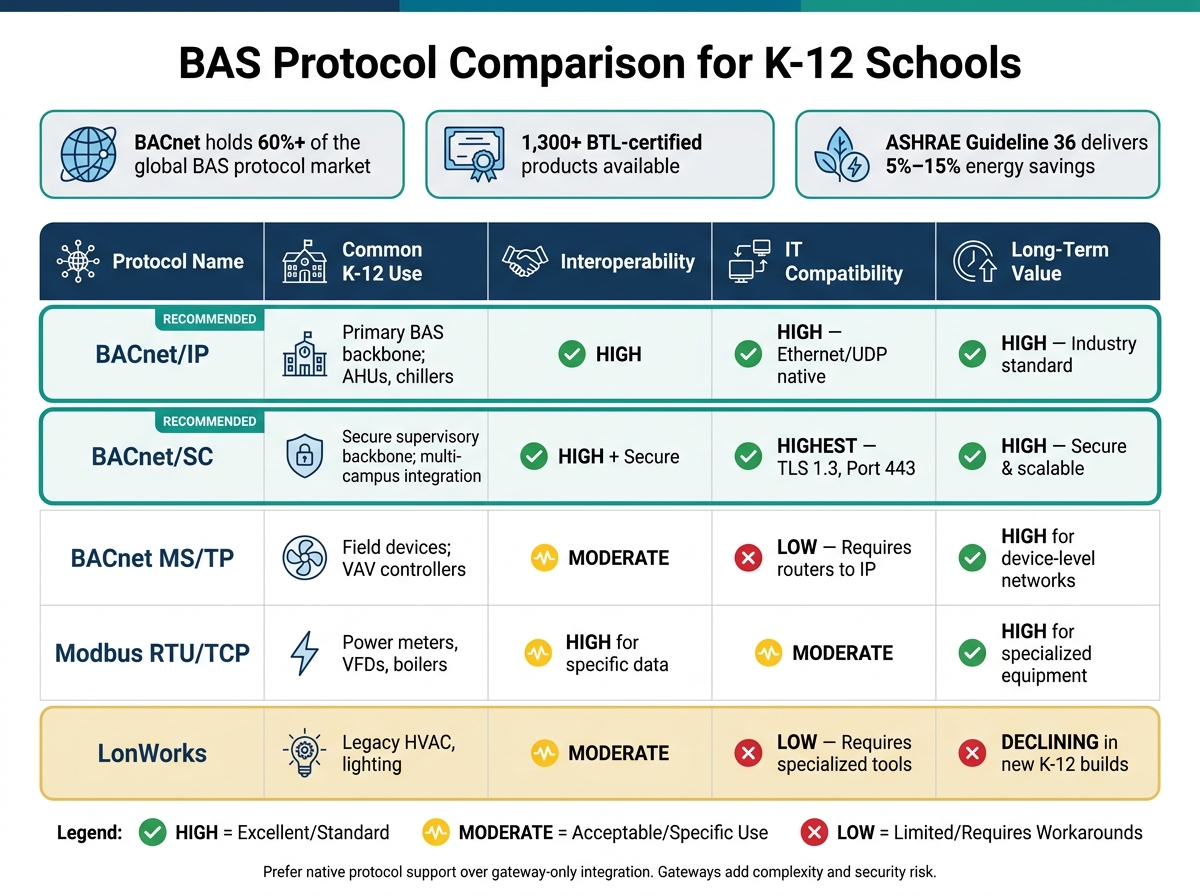
Open Protocol BAS for Schools: Protocol Comparison Guide
With the inventory done, the next step is to match each protocol to campus needs, future growth, and district IT rules. This choice shapes who can access the system, how far it can grow, and how much control the owner keeps.
Compare BACnet, Modbus, LonWorks, and IP-Based Integration
BACnet holds more than 60% of the global building automation protocol market, with over 1,300 BTL-certified products. Still, don’t take a vendor’s word for it. Check BTL listings yourself before you accept any compliance claim.
Use this mapping:
| Protocol | Common K-12 Use | Interoperability | IT Compatibility | Long-Term Value |
|---|---|---|---|---|
| BACnet/IP | Primary BAS backbone; AHUs, chillers | High | High; Ethernet/UDP native | High; industry standard |
| BACnet/SC | Secure supervisory backbone; multi-campus integration | High; secure | Highest; TLS 1.3 and Port 443 | High; secure and scalable |
| BACnet MS/TP | Field devices; VAV controllers | Moderate | Low; requires routers to IP | High for device-level networks |
| Modbus RTU/TCP | Power meters, VFDs, boilers | High for specific data | Moderate | High for specialized equipment |
| LonWorks | Legacy HVAC, lighting | Moderate | Low; requires specialized tools | Declining in new K-12 builds |
In most districts, BACnet/IP or BACnet/SC works best as the backbone. Modbus is a good fit for metering and other specialized equipment. LonWorks usually shows up in older systems, where a gateway or phased swap-out may be needed.
One simple rule helps here: prefer native protocol support over gateway-only integration. A gateway can help bridge a gap, but it can also turn a clean design into a patchwork.
After you pick the backbone, line up VLANs, IP addressing, and remote access rules with district IT before procurement is locked in.
Align BAS Architecture with District IT and Cybersecurity Standards
The BAS runs on the district network, so IT needs to review it before the system is picked or installed.
Put BAS traffic on dedicated VLANs. Keep controllers and main servers on one segment, wireless sensors and thermostats on another, and security systems on their own segment. Use static IP addresses for controllers so integrations stay predictable. For remote access, stick with VPN or encrypted HTTPS instead of opening direct ports to the internet [10].
BACnet/SC is becoming the better fit for new deployments. Older BACnet/IP depends on UDP broadcasts and may need BBMDs to cross subnets. BACnet/SC uses TLS 1.3 and X.509 certificates, which makes it easier to route across standard IT networks and easier to manage through firewalls [10].
That matters in day-to-day work. If IT has to fight the BAS every time traffic moves between campuses, the system becomes a headache fast. Put these network rules in the RFP so vendors have to treat them as part of the selection process, not something to sort out later.
Plan Multi-Campus Integration and District-Wide Monitoring
Once the network design is set, standardize naming and reporting across every campus.
A district with multiple schools needs one view for the whole portfolio. Facilities staff should be able to monitor alarms, review trends, change schedules, and pull reports across the district without signing into each building one at a time.
Standard naming conventions are a big deal here. If one campus labels an air handler as AHU-1 and another calls the same type of asset RTU-A North Wing, district-wide monitoring gets messy fast. Reports become harder to sort, alarms lose context, and staff waste time figuring out what they’re looking at.
Specify naming standards in the RFP so each campus reports data in the same format. Put those rules in writing so vendors deliver a district-wide standard instead of campus-by-campus variations.
Write the RFP to Protect Open Access and Service Flexibility
Once the network and naming rules are set, the RFP needs to lock them in with terms the vendor must meet.
Require Native Open Protocols and Full Owner Deliverables
Specify native BACnet/SC from controllers through the supervisory server. Do not allow third-party middleware for main protocol conversion. Gateways can add extra moving parts and more security risk. For each BACnet device, require the vendor to submit the BTL listing and the Protocol Implementation Conformance Statement (PICS) for the exact firmware version being installed.
At closeout, the district should receive everything needed to run and service the system on its own. That includes:
- Controls and documentation: Point list with names, units, and ranges; sequences of operation as implemented; as-built drawings for MEP and controls; TAB report; database and program backup; user roles and security settings; and a preventive maintenance plan
- Software and access: Full software licenses, configuration tools, admin credentials, and API documentation
- Training: Recorded hands-on sessions for reuse and quick-reference guides, with one to two pages per system type
Set Standards for Naming, Graphics, Testing, and Training
Final acceptance should depend on tested system performance, a complete handoff package, and staff training.
Require a complete points list in both CSV and PDF formats. Every point should include its name, engineering units (°F, cfm, kW, ppm), control range, and alarm setpoint [11][6].
Require sequences of operation as actually programmed, not just the design intent. The as-implemented version should be a condition of final acceptance [6][2].
Require Functional Performance Testing (FPT) across all operating modes, including occupied and unoccupied transitions, heating and cooling season changeovers, and power loss recovery [6]. Hold a 2.5% retention until seasonal commissioning tests are witnessed and passed [11].
Require at least two half-day hands-on training sessions for facilities staff. Those sessions should be recorded for reuse, and each system type should come with quick-reference and troubleshooting guides [6].
Use Procurement Language That Prevents Vendor Lock-In
The last step is to write procurement language that keeps the district in control after turnover.
Include these questions in the RFP as required written responses:
- "Describe how the district will purchase future BAS products." [3][5]
- "List software, licensing, version limits, and restrictions." [3][5]
- "State whether the API is open, documented, and available without a developer license." [3][5]
"You shouldn’t be precluded from having software to operate the system that you own… that is one of the single largest reasons why we have so many owners who can’t operate their systems." – Phil Zito, Founder, Smart Buildings Academy [3]
Also require written confirmation that the district can operate, service, and expand the BAS without vendor-only tools.
Implementation Roadmap and Conclusion
Phase the Rollout from Pilot Campus to District Standard
Once the RFP is done, start with one pilot campus before rolling anything out across the district. That gives you a clean way to prove the requirements in practice, not just on paper. Use the pilot to confirm interoperability across vendors and complete testing before a district-wide rollout.
The pilot should check the exact items already set in the plan: protocol fit, controls scope, naming conventions, cybersecurity boundaries, and handoff documentation. IT also needs to be involved early. Coordinate IP allocation, VLANs, and firewall rules before installation starts. And budget for growth from day one by requiring 20% spare I/O plus 10% spare switch ports [7][11].
After the pilot is commissioned and staff training is complete, document the process and turn it into the district standard for each campus that comes next. Keep naming, graphics, and reporting the same across campuses so maintenance is simpler and staff don’t have to relearn the system at every site [4].
If the pilot exposes gaps in scope or integration, fix those issues before moving to the next campus.
How a Design-Build Partner Can Support Planning and Integration
This is usually where coordination gets messy. HVAC, lighting, BAS, electrical, and IT all touch the same project, but they don’t always move in sync.
A design-build partner can help by managing those trades under one open-protocol scope. For Texas school districts, E3 Design-Build Contractor can support phased upgrades that combine HVAC, LED lighting, BAS, and infrastructure.
What to Check Before You Buy an Open Protocol BAS
Before award, run one last check against the district’s buyer criteria. Verify:
- district goals
- controls scope
- protocol fit
- IT sign-off
- native open protocols
- full owner access
- complete closeout deliverables
- BTL certification
- staff training
- seasonal commissioning [1][2][3][7][9][11][12]
The goal is simple: a BAS the district can own, run, and expand without depending on one vendor.
FAQs
How do we know if a BAS is truly open?
Look past the label. A BAS is only open if any qualified integrator can service it, change it, or add to it without being locked to a single manufacturer.
Here’s what to check:
- BACnet support
- BTL certification
- Each device’s PICS
You’ll also want to confirm there are no software, programming, or licensing limits that block access or control.
When should district IT be involved?
District IT should be involved early in planning so network and security issues get handled before they turn into last-minute problems. That includes remote access, cybersecurity, and OT segmentation.
Modern BAS often run on the school’s existing IT infrastructure. Because of that, IT should set the ground rules for IP address allocation, VLAN configuration, firewall rules, and internet connection requirements at least 60 days before commissioning.
What should a pilot campus prove first?
First, it should prove interoperability and integration. That means confirming that systems like HVAC and lighting controls can talk to each other and work together through open protocols such as BACnet.
It should also verify that data points are accurate and easy to access, so the BAS can support real-time monitoring, trend analysis, and demand response before a districtwide rollout.